A Strange Splendour

A vintage postcard of the surreal burn through the Cliffton’s cafeteria dining room.

What was I writing about 23 years ago? I was waxing lyrical about the high camp of a vanishing downtown Los Angeles. I published these essays in an online zine M and I edited called Die Cast Garden. I coded it using Dreamweaver made illustrations with Fireworks (before Adobe bought this software the pair were glorious, but I digress.) I found the zine on the miraculous Internet Archive’s Wayback Machine. 20 some years ago, Die Cast Garden was my answer to publishing in general—I couldn’t find an agent or publisher for my work so I made zines—xeroxed paper ones and HTML websites.

Last month, The Atlantic broke the news that Meta has used LibGen, an enormous database of copyrighted material, to train its AI, all while big publishing goes after The Internet Archive, a registered library using controlled digital lending and legal fair use.

When I look back at this work, now miraculously archived on the internet, it’s not with nostalgia but disorientation. How did we get from there—hand-coding websites that promised freedom from publishing hegemony—to this? Mega corporations indulge in piracy on a vast scale. For what?

I am playing cat and mouse: deleting X, coming off Meta, seeking an alternative to Substack. As I shuffle, it feels like disappearing.

But here is something the good internet has salvaged; may it be a boon.

Vintage postcard of Broadway at night, downtown Los Angeles

A Strange Splendor

When I moved to Los Angeles, I refused to be at home. I couldn’t go blonde or schmooze at parties. I wouldn’t drive a car. I walked it. Almost as a dare to myself, a dare to love this sprawl of a city, I began my search for its heart, for an L.A. I could claim, an LA of spooky movie palaces and other people walking, of Cumbia and cafeteria comfort food.

The search ended downtown, in the heart of the jewelry district. I walked down Broadway and came upon the then-closed Bradbury building– it was empty and dark, still. Gray rays of sun made their way down from the glass ceiling to illuminate the lacy iron work and gorgeous red wood. It was like looking into some strange church, all delicacy and logic, its congregation vanished while outside life throbbed: salsa boomed from storefront speakers, the Giant Penny sign a modest sun, a boot seller cried “Pasale! Pasale!,” girls and old women passed hand in hand as homeless men shuffled by and a bride with her bouquet and bridesmaid made their way down Broadway to a store front which offered Marriages and Divorces.

Now, anyone can enter the Bradbury Building; light floods it. It has been refurbished it to its original grandeur. A friendly guard will give you an information sheet explaining the building’s history. The only building by architect George Wyman, his dead brother spoke through an Ouija board, and suggested he take on the project.

[The Bradbury Building was made famous as a location in Bladerunner]

We have the treasure of the Bradbury building. So many other places, parts of the city’s history, have been torn down or left to decay. Much of the older architecture downtown has been reclaimed as mini-malls or “indoor swapmeets,” elegance replaced by an overwhelming abundance. It’s a bustling marketplace where you can get anything you want, and a great deal you wouldn’t want: fake doggie doo, fresh mangos, five dollar girdles, mood lipsticks, stereo equipment, and wind up GI Joes that crawl and shoot.

In the Broadway Arcade, this array of goods so distracted me at first that I did not look up, past the vendor’s plastic canopies to see the beautiful ceiling: hundreds of smog-encrusted glass panes forming an archway overhead, unable to compete with the cavalcade of goods below. Everywhere– dark forgotten corners, whole floors of abandoned, with all the activity going on below, at street level.

The Los Angeles and Orpheum theaters still show films, but most are now storefronts, the rest of the buildings vacant. One can still see the Palace’s shabby Florentine ceilings, or the baroque Bison heads on the Million Dollar Theater, once an Evangelical church and now up for lease. The Cameo houses electronic equipment and gold; The deco Roxie and the Globe theaters are full of bargain clothing. The State is a church, the Rialto now Discount Fashion. The Tower is empty.

A year ago, Broadway was under construction. Under generations of asphalt lie railroad ties. They were revealed during excavation; this place is always becoming something else. Ingenious immigrant communities sustain it, transforming it into a place of wonder and juxtapositions. Look up: the Pre-Columbian figures on the mural at fourth and Broadway dwarf you and tower over the “Little Angels” storefront filled with frothy communion gowns. On the same scale, a 7up bulletin board from the 80’s offers sun-bleached new wave.

Like everyone else bustling about, I come to shop and eat, go to the Million Dollar Botanica where you can pick up some Good Luck Floor Wax, cowry shells or a statue of scabby Lazarus while your prescriptions are filled, or stock up on dress socks at the Sixth Street Arcade, window shop for wedding gowns and work up an appetite. Then you can go to the neon and sawdust commotion of the farmer’s market. “Since 1917,” new red banners proclaim. Load up on pupusas and Tamarindo soda and check out the watch case by the sea food.

But if you are really after comfort, walk to Clifton’s Brookdale on Broadway. Partake of its sylvan fantasy and sit down on the miniature mountain. Watch the “limeade Springs” bubble by you. Here you get a good view of both the neon cross perched atop a tiny chapel and the moose head upstairs which stares back. There’s usually entertainment on weekends. On my most recent visit I had macaroni and cheese, beets in Mayo and flan as a woman sang Spanish ballads accompanied by a man with a Casiotone. Others, who knew the songs, ate and clapped along.

But the cafeteria isn’t always wholesome. According to “cruisingforsex.com” the toilets downstairs are “cruisy”– people meet in the Robinsons May Department store and walk down to the cafeteria because “it’s safer.” I cannot back this up with personal experience.

Vintage postcard of the waterfall facade of the Cliffton’s “Pacific Seas” location.

This is not the first Clifton’s. If you visit their website, http://www.clfitonscafeteria.com, you can see many vintage postcards of the different manifestations of Clifton’s. The original “Pacific Seas”, built in the 1930’s by Clifford Clinton, is now a parking lot– the intricate tropical façade with waterfalls and tropical foliage and sign reading “Pay What You Wish” are gone. But what a cafeteria it must have been. If only I’d been alive to see the Polynesian interior with real canaries, neon palms and a “rain hut” with showers every twenty minutes. Where else in the world could you eat chipped beef in such splendour?

My favorite Clifton’s, the Silver Spoon, almost thrived underneath the Orange smoggy awning at 7th and Olive until it was closed in the late 1990’s. While not as dramatic or beautiful as the Bradbury building, it was one of my favorite places. It had soul, and now it’s gone. Clifton’s moved there in the early 1970’s, though the building dates from the twenties.

The sign outside read, “The line from the door to the register takes about eleven minutes, but it’s worth the wait!” There was never any line when I went, only a few employees and elderly patrons. The old mahogany display cases were kept intact, and downstairs they were filled with old world knick knacks, ceramic ale mugs, pastoral-scene plates, and little clogs. Upstairs in the employee break room, the cases were untouched since the building’s jewelry store days. The cases displayed yellowed illustrations of earrings, chokers and bracelets, sending off black-penned rays of light. [How did I get in there? My younger self was intrepid. I miss her.]

The place just got stranger on the lower level, or “Soupeasy,” which featured a “The Garden, a Quiet Place for Meditation,” a hold over from the Pacific Seas location. This Garden was so quiet, you needed a token from the cashier to enter. Once inside you got a glimpse of a bench and glass case. On shutting the door you’re enveloped in darkness. Eventually, the lights in the life-sized diorama come on, illuminating a wax Jesus praying in Gethsemane. A disembodied voice, just like the nasal voice in a newsreel circa 1940 begins, “In these troubled times, many have died in war, but we live…many are homeless and hungry, yet we are fed and sheltered…” And one can’t help think that just outside the streets are filled with Angelenos—some are refugees, immigrants, and the displaced who’ve fled from poverty and their own war-torn countries, now meandering through the vendor’s stalls on the street above.

How strange to sit there listening to the sanctimonious voice, just after eating a meal of macaroni and gelatin, watch the colored lights illuminate Jesus in red and green, and not see it as funny. How strange to understand the innocence of the whole project, to be in that optimism, as the yellow light turns on the head of Jesus and the speaker closes, “Like Pontius Pilot, every man must ask himself, ‘What shall I do?'” And you are left in the dark to find the door.

My Own Personal psychopomp: revisiting Artist Mike Kelley

Ah…Youth! Mike Kelley, 1991. Image from the Tate website.

I’ve returned from my pilgrimage to London to see the Mike Kelley show, Ghost and Spirit at the Tate Modern, and I’ve recovered enough to process it.

A couple of days after Kelley’s death by suicide in 2012, I wrote a blog post which I revisit here. He was 57 when he exited, just two years older than I am now.

Most people know Kelley’s cover for the 1992 Sonic Youth album, Dirty, which frames forlorn handmade animal dolls in formal portraits along with Kelley’s youthful visage. Similar plush toys wound together in a monumental panel, suspended orbs, or situated alone on blankets defined Kelley’s work in the late 80s and early 90s. This work was received with the full force of biographical fallacy—critics assumed Kelley was making work about his own childhood trauma when really he wanted to talk about disposable consumer culture; he was in dialogue with feminist artists working in craft mediums.

More Love Hours Than Can Ever Be Repaid and Wages of Sin in the Tate show.

Kelley went on to embrace the autobiographical misunderstanding of his work as a direction, and much of his larger scale work of the early 2000s is about repressed memory, popular culture and shared trauma.

It’s hilarious and still full of pathos. A trickster figure in an art world that takes itself too seriously, Kelley remains one of my teachers. (Though I feel I am not ‘allowed’ to be funny, given the subject matter I write often about and atonal nature of writing online, but I digress.) Too many of my teachers—Plath, Sexton, Woolf and Kelley—have killed themselves. As I perch in yet another dark night of the soul, I wonder what this means to my own life.

I lingered in front of his most well known work, the tapestry of found handmade objects titled More Love Hours Than can Ever Be Repaid. It features not one but two yellow macrame owls, and a crocheted alligator that has remained with me in memory all these years. The whole thing is festooned with that staple of American midwestern decor—sheaves of rainbow corn. Here is a visceral return to the tactless grottos of my 1970s childhood: beautiful, gross, paltry. I went to the show with two friends, one who grew up in the UK and the other in Canada, and all three of us related to the wax candle sculpture, The Wages of Sin. We knew these 70s-80s ornately crafted candles by heart even if we had never seen them before.

Detail of The Poltergeist (Ectoplasm Photographs) 1978

Kelley deconstructed the aesthetics of hysteria, mysticism and nostalgia. He marked out the absurdities of patriarchy and toxic masculinity and made them hilarious.

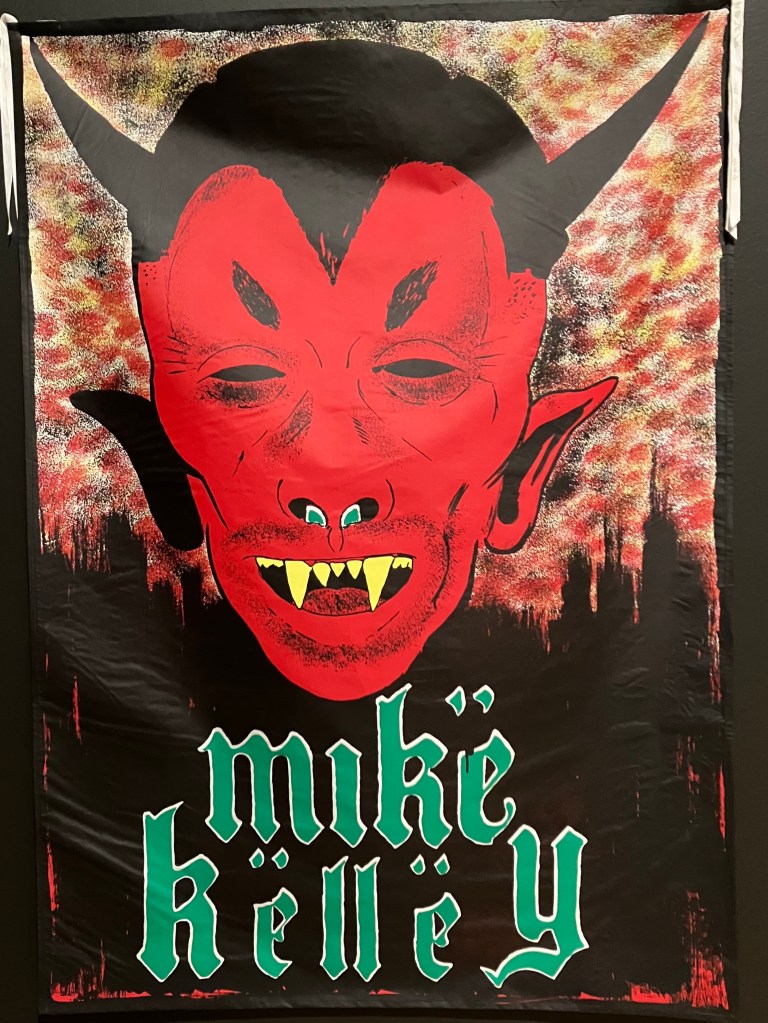
Seeing the work in the austere, high ceilinged Tate, I was struck with how low brow it felt: here were drawings that look like they were made with shit, Rat Fink demons cavorting, adolescent doodles and bad tattoo art writ large on flags.

Satan’s Nostrils, 1986

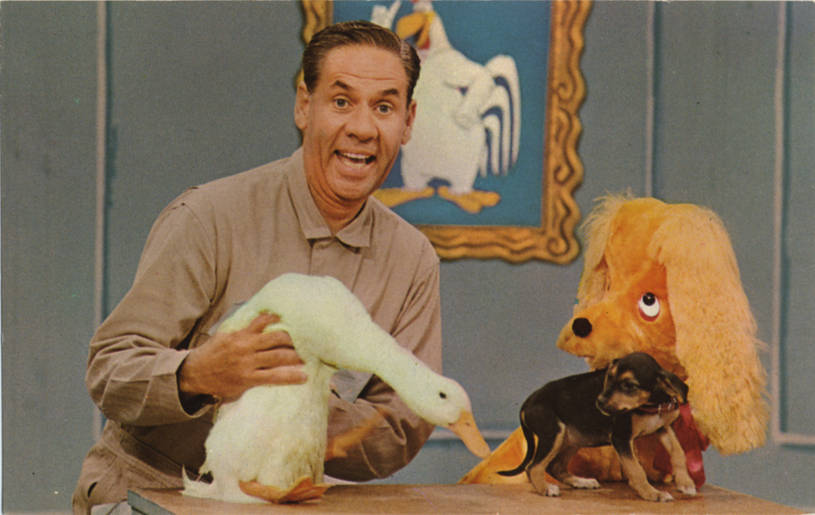
When I first saw his work as a wayward teen, I felt as if we—he and the viewer—were in on some great prank. We were getting away with it because I got the joke. Kelley’s midwestern accent sounded like home. We both grew up in the suburbs of the American Midwest. Kelley’s Banana Man, a video performance of existential angst where Kelley, dressed in a yellow sailor ‘leisure’ suit covered in pockets, tells a story of slapstick woe. Banana Man is tied in my mind to Chicagoland TV legend Ray Rayner, whose 1970s children’s morning show featured cartoons, crafts, corny jokes and leisure suits. I saw Banana Man in 1988 and had a revelation: if I lived in a world where this art could happen, it meant I was free of all the dumb shit I’d been made to carry as a girl. Here was all the permission I needed.

Ray Rayner of Chicagoland Morning teevee, circa 1970

In the Tate show, Kelley’s birdhouse ‘spirit collector’ sits under glass like a specimen. The howl & drum of sounds from his shamanistic ritual performance at Los Angeles Contemporary Exhibitions space plays over it. In this room, his early work is reshuffled, creating a ghostly feeling that wasn’t there initially—adding dimension for a world still mourning his passing.

Mike Kelley as Banana Man, 1981

(I once exhibited my work at LACE, but it was so long ago. Unambitious thing I am, I never wrote that stuff down, and now can’t remember which piece it was. There was still a pang of what-might-have-been watching LACE’s interior projected on a wall in the Tate in London).

As an older woman revisiting this work nearly 40 years on, I now see Kelley’s sincerity, something I didn’t pick up on as a young woman. The Tate curation is apt and bittersweet, framing his work as ghost narratives.

My favourite pieces in the show were the Kandor jars. (What is it about THINGS IN JARS? something else to unpack…) In the Superman comic, Kandor is the lost city from Superman’s home-world, shrunken down and preserved in a bell jar. Kelly creates myriad lurid and inviting versions of the tiny city. In a companion video piece, Superman Recites Selections from ‘’The Bell Jar and Other Works by Sylvia Plath‘ (1999), a square-jawed Superman, played with grave earnestness by Michael Garvey, recites excerpts from Plath. Plath was an American immigrant in the UK and knew well the melancholy of lost home. The Kandor jars are iterations of the cliche ‘you can never go home again’—illuminated by a wonder particular to childhood and adolescence, or at least what we remember childhood to have been.

Are my own memories of Kelley’s work and his fleeting presence like some candy-coloured resin kingdom, aglow with loss?

The Tate show ends with Kelley’s video Bridge Visitor (Legend Trip.) A legend trip is a teenage rite of passage involving urban folklore pilgrimages to creepy sites—the starting point of many 80s horror stories. In many ways Ashes & Stones was a six-year legend trip…but I haven’t unpacked that yet. Kelley exploits the cliched, dark heart of adolescence with ‘Satanic’ vocals and a literal pissing contest. A stream of urine puddles in darkness, becoming a magic mirror to a chthonic underworld. Kelley is literally taking the piss, making something new and taking us with him. At the end, a spectral troll appears hamming it up like a low-res Butoh dancer played by Kelley himself, naked, liminal and entrancing.

Revisiting Kelley’s work was also legend trip. I have no idea if I would get him now—all-at-once—like this had I not had this decades long relationship with his work. Kelley is my own personal psychopomp leading the way-but through what? Surely away from midlife to something else more sublime.


Simon Wu’s review of the Tate show in Momus is so good: https://momus.ca/a-very-real-american-place-the-suburban-unconscious-in-mike-kelley/

Below is my blog piece from 2012

R.I.P. Mike Kelley

February 2, 2012

The news of L.A. artist Mike Kelley’s suicide has left me reeling and bereft. The world is suddenly a much less interesting place without him.

Mike Kelley was perhaps my first real art world love. I’d shaken off my infatuation with the Preraphaelites in high school and signed up for the whole art school experience as a rebellion, as a middle finger to all the other choices I didn’t have at the time. I had no voice of my own, no medium I’d mastered. I was stumbling along, and I stumbled on Kelley.

I remember going to the Newport Harbour Art Museum [Now the Orange County Art Museum] in 1988. This guy I’d never heard of had a solo show with video of performance art like The Banana Man and Kappa (a scatological Japanese fairy). There were things made out of crocheted animals. Freud and everything else was turned on its head. My heart beat faster, looking at this show. I went back over and over. Having never been to a circus, I felt like a kid who’d been taken to see the clowns for the first time: terrified and giddy.

Later, Kelley actually came to my school to speak. He was one of the few artists and writers who meeting in person was not a let-down. The school I attended in the late 80s did indeed suck– not least because the chair at the time was sexually assaulting and ritually humiliating women students. (Later, a group of women won a lawsuit against the school and my witness statement was integral to the case, but that is a matter for another post.)

In this darkness, Kelley was a light–he was a feminist artist, deconstructing received notions of the body and framing women’s work in subversive ways. He showed up to my Art Fundamentals class looking like a sinister mod, with his black bob and pegged trousers. He was funny, captivating, and able to talk about very dark things with a lightness. Beneath it all was a sly compassion. [When I spoke to him, he treated me as an equal—in a world of bully art men this was as disarming as seeing his work for the first time. In hindsight, he was also the first person to take me seriously as an artist.]

Though I ended up working in very traditional mediums–oils and etching on zinc plates–I carried Kelley’s work around with me as a reminder of what is possible.

I can only think his suicide is some sort of medical failure– depression too often goes untreated. I end with this youtube video and hope it isn’t in bad taste– in it Mike Kelley talks about what he’s buying at Ameoba Music in Hollywood. It sums up for me his unassuming presence and his creepy fascinations and characteristically gleeful attitude toward the abject. I can’t believe he’s gone.