A Strange Splendour

A vintage postcard of the surreal burn through the Cliffton’s cafeteria dining room.

What was I writing about 23 years ago? I was waxing lyrical about the high camp of a vanishing downtown Los Angeles. I published these essays in an online zine M and I edited called Die Cast Garden. I coded it using Dreamweaver made illustrations with Fireworks (before Adobe bought this software the pair were glorious, but I digress.) I found the zine on the miraculous Internet Archive’s Wayback Machine. 20 some years ago, Die Cast Garden was my answer to publishing in general—I couldn’t find an agent or publisher for my work so I made zines—xeroxed paper ones and HTML websites.

Last month, The Atlantic broke the news that Meta has used LibGen, an enormous database of copyrighted material, to train its AI, all while big publishing goes after The Internet Archive, a registered library using controlled digital lending and legal fair use.

When I look back at this work, now miraculously archived on the internet, it’s not with nostalgia but disorientation. How did we get from there—hand-coding websites that promised freedom from publishing hegemony—to this? Mega corporations indulge in piracy on a vast scale. For what?

I am playing cat and mouse: deleting X, coming off Meta, seeking an alternative to Substack. As I shuffle, it feels like disappearing.

But here is something the good internet has salvaged; may it be a boon.

Vintage postcard of Broadway at night, downtown Los Angeles

A Strange Splendor

When I moved to Los Angeles, I refused to be at home. I couldn’t go blonde or schmooze at parties. I wouldn’t drive a car. I walked it. Almost as a dare to myself, a dare to love this sprawl of a city, I began my search for its heart, for an L.A. I could claim, an LA of spooky movie palaces and other people walking, of Cumbia and cafeteria comfort food.

The search ended downtown, in the heart of the jewelry district. I walked down Broadway and came upon the then-closed Bradbury building– it was empty and dark, still. Gray rays of sun made their way down from the glass ceiling to illuminate the lacy iron work and gorgeous red wood. It was like looking into some strange church, all delicacy and logic, its congregation vanished while outside life throbbed: salsa boomed from storefront speakers, the Giant Penny sign a modest sun, a boot seller cried “Pasale! Pasale!,” girls and old women passed hand in hand as homeless men shuffled by and a bride with her bouquet and bridesmaid made their way down Broadway to a store front which offered Marriages and Divorces.

Now, anyone can enter the Bradbury Building; light floods it. It has been refurbished it to its original grandeur. A friendly guard will give you an information sheet explaining the building’s history. The only building by architect George Wyman, his dead brother spoke through an Ouija board, and suggested he take on the project.

[The Bradbury Building was made famous as a location in Bladerunner]

We have the treasure of the Bradbury building. So many other places, parts of the city’s history, have been torn down or left to decay. Much of the older architecture downtown has been reclaimed as mini-malls or “indoor swapmeets,” elegance replaced by an overwhelming abundance. It’s a bustling marketplace where you can get anything you want, and a great deal you wouldn’t want: fake doggie doo, fresh mangos, five dollar girdles, mood lipsticks, stereo equipment, and wind up GI Joes that crawl and shoot.

In the Broadway Arcade, this array of goods so distracted me at first that I did not look up, past the vendor’s plastic canopies to see the beautiful ceiling: hundreds of smog-encrusted glass panes forming an archway overhead, unable to compete with the cavalcade of goods below. Everywhere– dark forgotten corners, whole floors of abandoned, with all the activity going on below, at street level.

The Los Angeles and Orpheum theaters still show films, but most are now storefronts, the rest of the buildings vacant. One can still see the Palace’s shabby Florentine ceilings, or the baroque Bison heads on the Million Dollar Theater, once an Evangelical church and now up for lease. The Cameo houses electronic equipment and gold; The deco Roxie and the Globe theaters are full of bargain clothing. The State is a church, the Rialto now Discount Fashion. The Tower is empty.

A year ago, Broadway was under construction. Under generations of asphalt lie railroad ties. They were revealed during excavation; this place is always becoming something else. Ingenious immigrant communities sustain it, transforming it into a place of wonder and juxtapositions. Look up: the Pre-Columbian figures on the mural at fourth and Broadway dwarf you and tower over the “Little Angels” storefront filled with frothy communion gowns. On the same scale, a 7up bulletin board from the 80’s offers sun-bleached new wave.

Like everyone else bustling about, I come to shop and eat, go to the Million Dollar Botanica where you can pick up some Good Luck Floor Wax, cowry shells or a statue of scabby Lazarus while your prescriptions are filled, or stock up on dress socks at the Sixth Street Arcade, window shop for wedding gowns and work up an appetite. Then you can go to the neon and sawdust commotion of the farmer’s market. “Since 1917,” new red banners proclaim. Load up on pupusas and Tamarindo soda and check out the watch case by the sea food.

But if you are really after comfort, walk to Clifton’s Brookdale on Broadway. Partake of its sylvan fantasy and sit down on the miniature mountain. Watch the “limeade Springs” bubble by you. Here you get a good view of both the neon cross perched atop a tiny chapel and the moose head upstairs which stares back. There’s usually entertainment on weekends. On my most recent visit I had macaroni and cheese, beets in Mayo and flan as a woman sang Spanish ballads accompanied by a man with a Casiotone. Others, who knew the songs, ate and clapped along.

But the cafeteria isn’t always wholesome. According to “cruisingforsex.com” the toilets downstairs are “cruisy”– people meet in the Robinsons May Department store and walk down to the cafeteria because “it’s safer.” I cannot back this up with personal experience.

Vintage postcard of the waterfall facade of the Cliffton’s “Pacific Seas” location.

This is not the first Clifton’s. If you visit their website, http://www.clfitonscafeteria.com, you can see many vintage postcards of the different manifestations of Clifton’s. The original “Pacific Seas”, built in the 1930’s by Clifford Clinton, is now a parking lot– the intricate tropical façade with waterfalls and tropical foliage and sign reading “Pay What You Wish” are gone. But what a cafeteria it must have been. If only I’d been alive to see the Polynesian interior with real canaries, neon palms and a “rain hut” with showers every twenty minutes. Where else in the world could you eat chipped beef in such splendour?

My favorite Clifton’s, the Silver Spoon, almost thrived underneath the Orange smoggy awning at 7th and Olive until it was closed in the late 1990’s. While not as dramatic or beautiful as the Bradbury building, it was one of my favorite places. It had soul, and now it’s gone. Clifton’s moved there in the early 1970’s, though the building dates from the twenties.

The sign outside read, “The line from the door to the register takes about eleven minutes, but it’s worth the wait!” There was never any line when I went, only a few employees and elderly patrons. The old mahogany display cases were kept intact, and downstairs they were filled with old world knick knacks, ceramic ale mugs, pastoral-scene plates, and little clogs. Upstairs in the employee break room, the cases were untouched since the building’s jewelry store days. The cases displayed yellowed illustrations of earrings, chokers and bracelets, sending off black-penned rays of light. [How did I get in there? My younger self was intrepid. I miss her.]

The place just got stranger on the lower level, or “Soupeasy,” which featured a “The Garden, a Quiet Place for Meditation,” a hold over from the Pacific Seas location. This Garden was so quiet, you needed a token from the cashier to enter. Once inside you got a glimpse of a bench and glass case. On shutting the door you’re enveloped in darkness. Eventually, the lights in the life-sized diorama come on, illuminating a wax Jesus praying in Gethsemane. A disembodied voice, just like the nasal voice in a newsreel circa 1940 begins, “In these troubled times, many have died in war, but we live…many are homeless and hungry, yet we are fed and sheltered…” And one can’t help think that just outside the streets are filled with Angelenos—some are refugees, immigrants, and the displaced who’ve fled from poverty and their own war-torn countries, now meandering through the vendor’s stalls on the street above.

How strange to sit there listening to the sanctimonious voice, just after eating a meal of macaroni and gelatin, watch the colored lights illuminate Jesus in red and green, and not see it as funny. How strange to understand the innocence of the whole project, to be in that optimism, as the yellow light turns on the head of Jesus and the speaker closes, “Like Pontius Pilot, every man must ask himself, ‘What shall I do?'” And you are left in the dark to find the door.

Making truth irresistible

Despair is a land we move through. We should not be building any buildings there.

Akaya Windwood in conversation with Rebecca Solnit

In this Missive:

  • Thoughts on moving through despair & making truth irresistible
  • Practical tips for making your online life less oppressive
  • A Mastodon primer

June Jordan once said her function as a poet was to make revolution irresistible. Well OK, that is the function of us all, as creative artists: to make the truth irresistible. —Audre Lorde

We are at a crossroads. Our online spaces are changing whether we stay on big socials or not. I am interested in building and fostering better places online—places that are irresistible, where truth can flourish. I’ve realised recently that I can’t do this while also showing up at the old places, despite the community there wanting me to keep feeding that machine.

Our dilemma is real. For me, every professional contact I have operates on IG. (And X, but I have deleted that account.) Others have families, friends and audiences they have built over 15+ years. Some may be able to leave all at once, but for others, this disengagement will be gradual.

My last Substack post about lifeboats off big socials touched a nerve. There was fruitful discussion—but a backlash of defensiveness. I am not proposing a boycott. Using Meta products isn’t a purity test. Staying or going is not a moral stance.

Many of us were already uncomfortable with or perpetually drained by these platforms. Those of us feeling the most pressure are usually creatives driven to promote our work so that we can survive financially.

Meta and X are giving disinformation and hate speech a permanent place in our shared spaces. Big socials are mining our connections, not just for marketing but for the dissemination of hate, the erosion of human rights and the criminalisation of healthcare for women and trans folks. [Let me be clear about what I mean below: a trigger warning for anyone not wanting to read about abortion bans in the USA.*]

There’s something to say about those places we are not.’ —Liz Ogbu in conversation with Rebecca Solnit on Blue Monday

This change at Meta is not sudden, though it might feel like it. Everything feels sudden these days—part of a psyops shock-and-awe strategy of despots. This hostile shift hits us where we live. The power men like Zuckerberg and Musk have been given over our lives and the mediation of our relationships is immense.

Many of our friends, allies and chosen family have already been driven out, and more will leave. This shift at Meta is another kind of gentrification. Some of us pay higher ‘rent’ to Meta—artists, writers and other creatives pay in ideas and skills we have mastered over decades. This unpaid ‘content’ is now fed to AI behemoths that devour it and spit out again.

Did I love my community on Meta products? Yes. But I don’t know if I can’t take it with me. I don’t know if that love is portable.

If we are only looking at what will please the algorithm rather than what is true, we are reduced to selfies and cynical, reactive hot-takes. Sometimes, if we really need to be seen on the platform, we pay in with images of our faces and bodies. The cost can be high in other ways: some have endured cyberbullying, censorship, unwanted attention, and cyberstalking on Meta platforms. This is about to get much worse for the most vulnerable in our communities.

Some of us have had to leave communities/families/institutions in order to survive. Gentrification, hostile environment and abuse have forced us to make a choice. Sometimes I feel I’m being driven out, just like I was by these inchoate tech bros in San Francisco in the early 90s. The thing is, I took that love of place with me. I am the embodiment of SF circa 1989. (That is the subject for another post. In the parlance of our times, IYKYK.) In other places like Long Beach, California and London, I hung on a bit longer and brought that love with me. Did I love my community on Meta products? Yes. But I don’t know if I can’t take it with me. I don’t know if that love is portable.

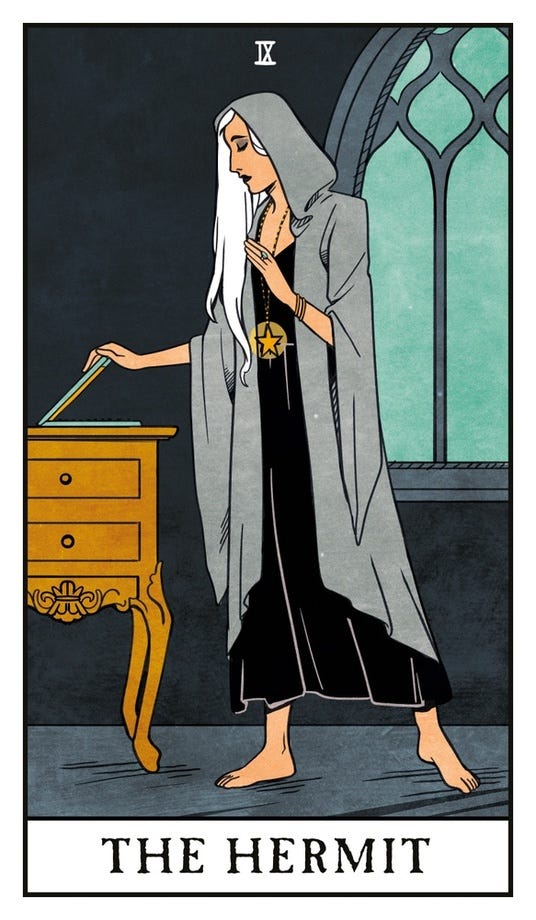
A hermit tarot card featuring a white haired femme person in a grey cloak, standing before a gothic window at twilight. They are closing a laptop and looking thoughtful, their gestures are elegant
Closing the laptop is also an option. The Hermit from the Modern Witch Tarot

In a discussion around the changes at Meta, Angela Maria Spring offered some wise words. (Watch out for Angela’s poetry collection coming out from FlowerSong in the near future)

“It’s Hermit year and I think we need to begin thinking smaller again. Like hermit crabs finding new little shells and seeking our immediate communities. This newsletter is one of those immediate communities we’ve chosen. We can interact with you within your boundaries and still information and resource share. In fact, the less time we dedicate to mindless scrolling, the more time we have to attend each other. The idea that we must reach AS MANY people as possible is dangerous on multiple levels. It makes the reaching of even one person less meaningful…Our attention one of the most valuable things we possess in this broken system, let’s take it back.”

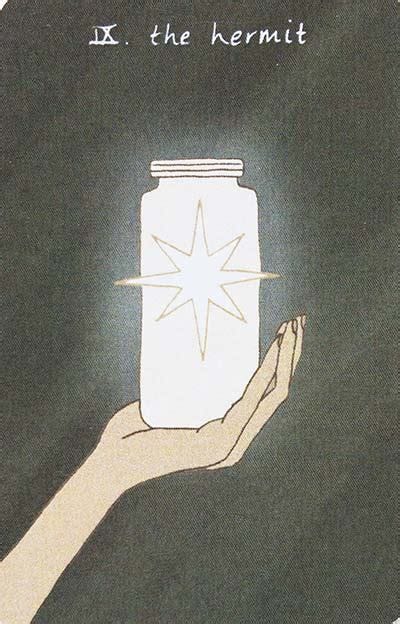
A minimalist tarot card with a dark great background, A simple drawing of a hand holding a jar containing a bright star. Roman numerals 9 and The Hermit head the image
The Hermit from the Mesquite Tarot

Angela reminded me that in the Major Arcana tarot cycle, this year corresponds to The Hermit. The Hermit from the Mesquite tarot, above, is my favourite Hermit card. The star inside the lantern on the Rider-Waite-Smith tarot card becomes the very essence of The Hermit. This star-in-a-jar is tiny; its confinement is also a healthy delineation of boundaries. A bright seed illuminates a makeshift lantern.

This star-in-a-jar year welcomes the return of sub-culture. It abandons the metrics of follower counts in favour of authentic connection and reciprocity. It feels small but is irresistibly true, and bright.

Our transitions to other online spaces will take tinkering, trial and error and patience. I think about my first computer in the early 90s. Artist Glen Kaino helped me set it up. He made it seem like we were making mud pies, as if nothing could go wrong. When I was up and running, I got copies of Geek Girl zine, which took the same attitude towards tech. (This zine from the 90s is archived at the Wayback Machine).

Let’s share other ways of doing things. I want to help build something else. I’m not running away or reacting out of fear. I’m phasing out big social as I make something better. Those of us that have had enough, let’s go, and nurture the spaces that hold us well. Let’s create them if they don’t exist yet.

Those of us that remain on big socials must question our habitual passivity in the face of what’s coming or perhaps already here—the exploitation of our most vulnerable friends, family and allies. Some have told me they will subvert or redeem Meta or X from working on the inside.

Audre Lorde, from her speech addressing a women’s conference in 1984:

“For the master’s tool will never dismantle the master’s house. They may allow us temporarily to beat him at his own game, but they will never enable us to bring about genuine change. And this fact is only threatening to those women who still define the master’s house as their only source of support.”

Lorde, Audre. “The Master’s Tools Will Never Dismantle the Master’s House.” 1984. Sister Outsider: Essays and Speeches.

Is Meta/X our only source of support? How does it taste to say Lorde’s words, standing where we find ourselves?

Our reality counters to the hellscape foisted on us, but we must maintain the connections and keep telling the stories that make it real. The rebellion will start with the discovery of new tools, with astonishment, wonder, and showing up for each other.

We need to be talking amongst ourselves and building our stories. —Charlie Jane Anders

Some Tools to Make Your Online Life Less Oppressive

Turn of AI in Gmail & Web Search:

I use Gmail, so my emails are mined for AI. I never liked the ‘tab’ sorting, so I have found a way to turn this off as well as turn off AI crawling. (It also turns off filing newsletters like this one as ‘promotions’. All emails will be in your inbox.) Here are step by step instructions.

AI Free Google search is a revelation!

Use this URL work-around to see how much information is available when not filtered through AI. https://udm14.com/

Other Online Communities not tied to Meta or Venture Capital:

These are online communities I use regularly and can recommend. There are many others like Ampwall (alternative to bandcamp), Ghost (alternative to Substack) and Pixelfed (not really a replacement for IG, but being touted as such). Do you use any others you recommend?

How to MASTODON in 8 easy steps.

Mastodon is a user-supported social media network. It is free to use and is also AD FREE. (Some users donate to the people hosting their servers, but this is optional). Mastodon has a chronological timeline, no algorithm, and allows for infinite customisation. It is not tied to venture capital in the same way as Bluesky. Already there? Share your profile in the comments.

  1. Watch Mastodon explained in 180 seconds.
  2. Find an instance to join. It’s the place that hosts your account, and usually you can talk to all other accounts on the Fediverse (though many instances block fascist instances like Truth Social, etc.) My instance, Wandering.shop, is invite-only. Beige.party is a super cool instance with good folks on it and requires no invitation. You can find other instances based on your interests or geographical location. (Your instance will have a ‘local’ feed where you can see what everyone on your server is posting—like a community within a community).
  3. Populate your bio with a picture (include alt text for it in your bio). Say a bit about who you are and what you are into.
  4. First Post—make it an introduction with as many hashtags as you can think of that explain your interests or communities you’d like to connect with. Like #knitting, #Tarot, #WritingCommunity, etc. Pin this post to your timeline so it’s the first thing people see.
  5. Follow hashtags to find your peeps—search for your favourite hashtags in the search bar, and click ‘follow hashtag’—this will populate your feed with cool stuff while you find your people. I enjoy following #Mosstodon, #Tarot and #StandingStoneSunday as well as #Caturday.
  6. Have friends/chosen fam or favourite accounts? Tag the ‘bell’ next to someone’s name on their profile and their posts will appear in your notifications so you’ll never miss them.
  7. You can use Mastodon on your desktop or phone. Download the Mastodon App for free, or the Metatext app. Both work great.
  8. Retoot (share on your timeline using the little arrows-square at the bottom of a post in your timeline) anything you think is cool or interesting. That’s what keeps Mastodon humming along—people sharing others’ work.

And a few more tips:

—Block with abandon! Don’t like someone’s ooky vibe? Some stranger’s adversarial tone? That random reply guy lurking around?BLOCK THEM and cackle with glee.

—Check out some other tips.

—Follow blogs and Bluesky accounts via your Mastodon timeline with RSS Parrot.

—Check out Meljoann’s guide to deleting Meta and joining the Fediverse

Something to dance to while you untangle yourself from Big Social

We have a theme song. (Thanks, @Meljoann!)

https://boyscoutaudio.bandcamp.com/track/bye

——————————————————————-

*One ‘breaking point’ for me was hearing last year that legislators in South Carolina have introduced a bill which would criminalise abortion as murder. If a woman were convicted, she would face the 30 years without parole or the death sentence in that state. In the past FB has handed over ‘private’ chats between family members as evidence. This is not looking good. After having spent seven years with the words of women about to be executed for an invented crime, I had to really think hard about where I wanted to be.

This post was first published here.

Life Frafts for everyone

Earlier this week, the owner of Meta set out a six point plan to disseminate disinformation and allow hate speech on Facebook and IG. In a recent essay on my Substack I’ve outlined a response to the collapse of truth on Meta, including some background on the crisis and ideas about going forward.