Allyson Shaw’s Ashes & Stones is a remarkable book, one I imagine I will return to over the years when I want to be reminded of how magic works in literary form.
It is a truly staggering example of how one might balance memory and dream and scholarship and imagination and empathy to create a multifaceted portrait that, without pretending at perfect accuracy…manages to bring long-lost women to enough of a semblance of life that it feels as though they are walking along the hills and the water and the old roads alongside their author and her readers.
I’m gearing up to lauch the Kickstarter for my debut novel, Widdershins, and I thought I would show you a sneak peak of the premiere tier, The Witch, and what inspired it. Sign up here to be notified when the Kickstarter launches on April 30th of this year.
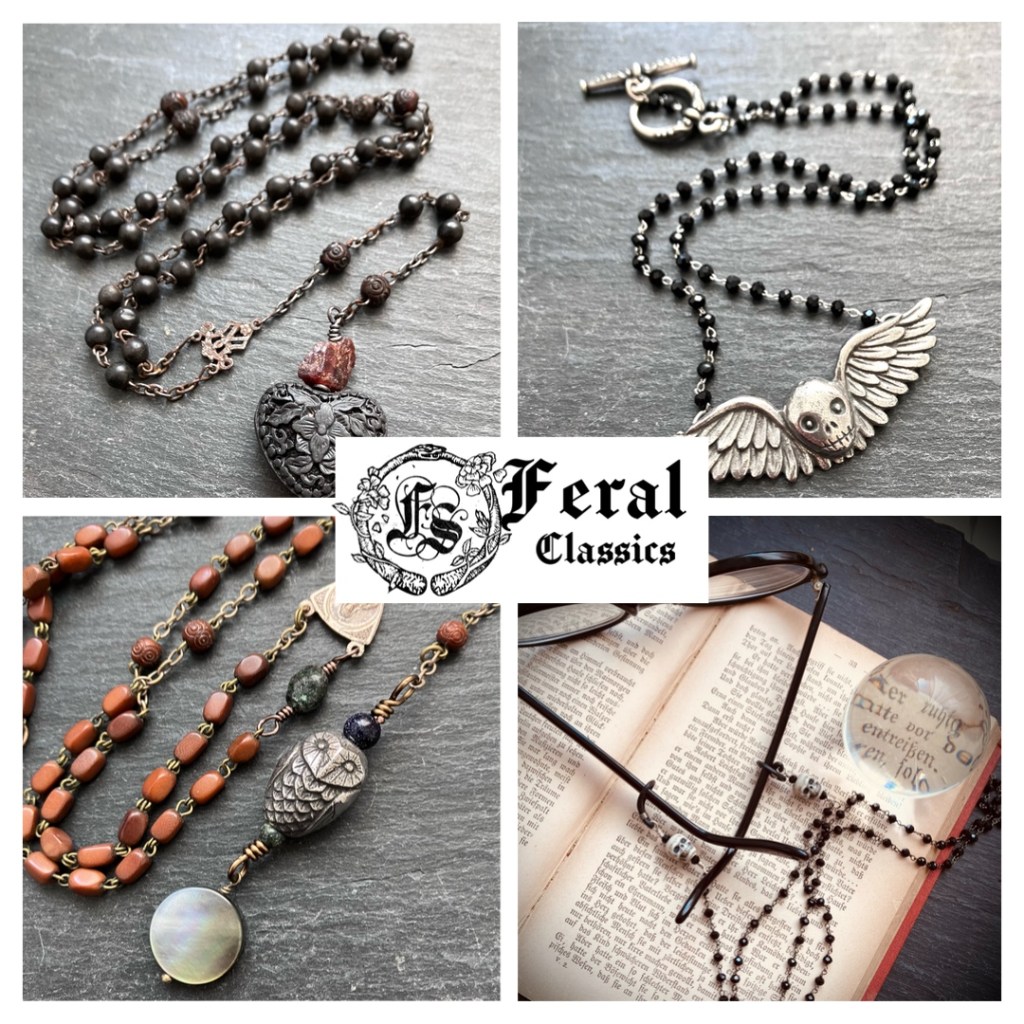
Ten years ago I wrote a guide to witch’s beads, sometimes called Pagan prayer beads or Pagan rosaries. It was informed by custom designs I created for other witches, Pagans and Heathens. For the last 15 years I have run Feral Strumpet, a handmade adornment and altar supply business. I once made custom strands for people who used them in devotion or simply wore them. I also repurposed broken rosary beads, giving them new life.
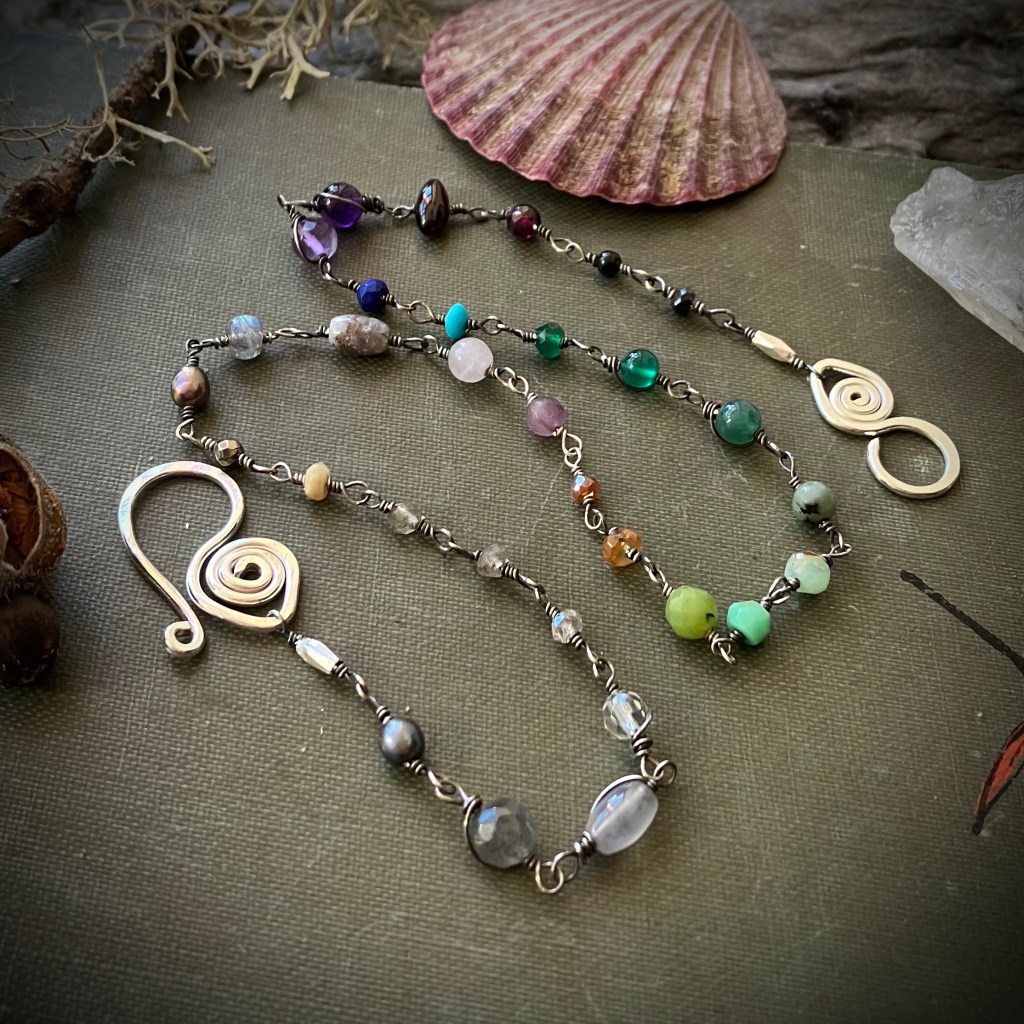
While I can no longer make those beaded strands as custom designs, I do still make what I call Witches Ladder necklaces—each is a one of a kind sterling silver necklace made with links of semi precious stones, all inspired by the colours of the Orkney landscape where I live.
As part of the Widdershins Kickstarter, I will be offering one of a kind, necklaces handmade by me as part of the Witches Tier. [The way Kickstarter works: supporters of a project like Widdershins choose a tier, and each tier comes with unique rewards once the project is funded. Kickstarter is all or nothing—only projects that meet their funding goals are funded.]
The article I wrote in 2016 links this meditative metal working technique used in my witches ladder necklaces to my writing process. Interlocking spirals also give shape to the story of my novel Widdershins!
Some rosary inspired designs I’ve been making for the last 15 years!
Here is the article I wrote for my shop blog in 2016
Catherine wearing a repurposed rosary fragment necklace
The use of a strand of beads in prayer is universal across almost all faiths, but is well known in the form of the Catholic rosary. I have collected rosaries since I was a teenager. Often I would find them in the street, in thrift shops or at flea markets. I have refurbished them and sold them whole again, reused the fragments but I have also listened to them. Some wanted to be something else entirely, and perhaps this is why they found their way to me.
I have always loved them, perhaps because they are a physical representation of devotions to Mary. They were the first meditations to a goddess—a divine woman and alternative to God the father—I had ever known.
Some witches, like myself, have come from a Christian path and may miss certain aspects of those rituals. A wonderful article about this can be found on Patheos, Retooling the Rosary. The meditative rhythms of the beads reflect the rhythms of the earth. Pagan prayer beads can use many of these for their structure–the four seasons, the phases of the moon, the 8 Sabats or 13 Esbats, the 24 runes in the Elder Furthark. I am partial to nines—the spinning number of three times three. Odin hung on the tree for 9 days and there are 9 worlds in the Norse cosmos. The ubiquitous 9 maidens in folklore also inform my designs.
Even in my secular jewellery—meant simply to be worn and enjoyed—the hand wrapped rosary links I make are very meditative. Some designs take on a devotional feeling as I make them, much like the rhythms of tying a witches ladder.
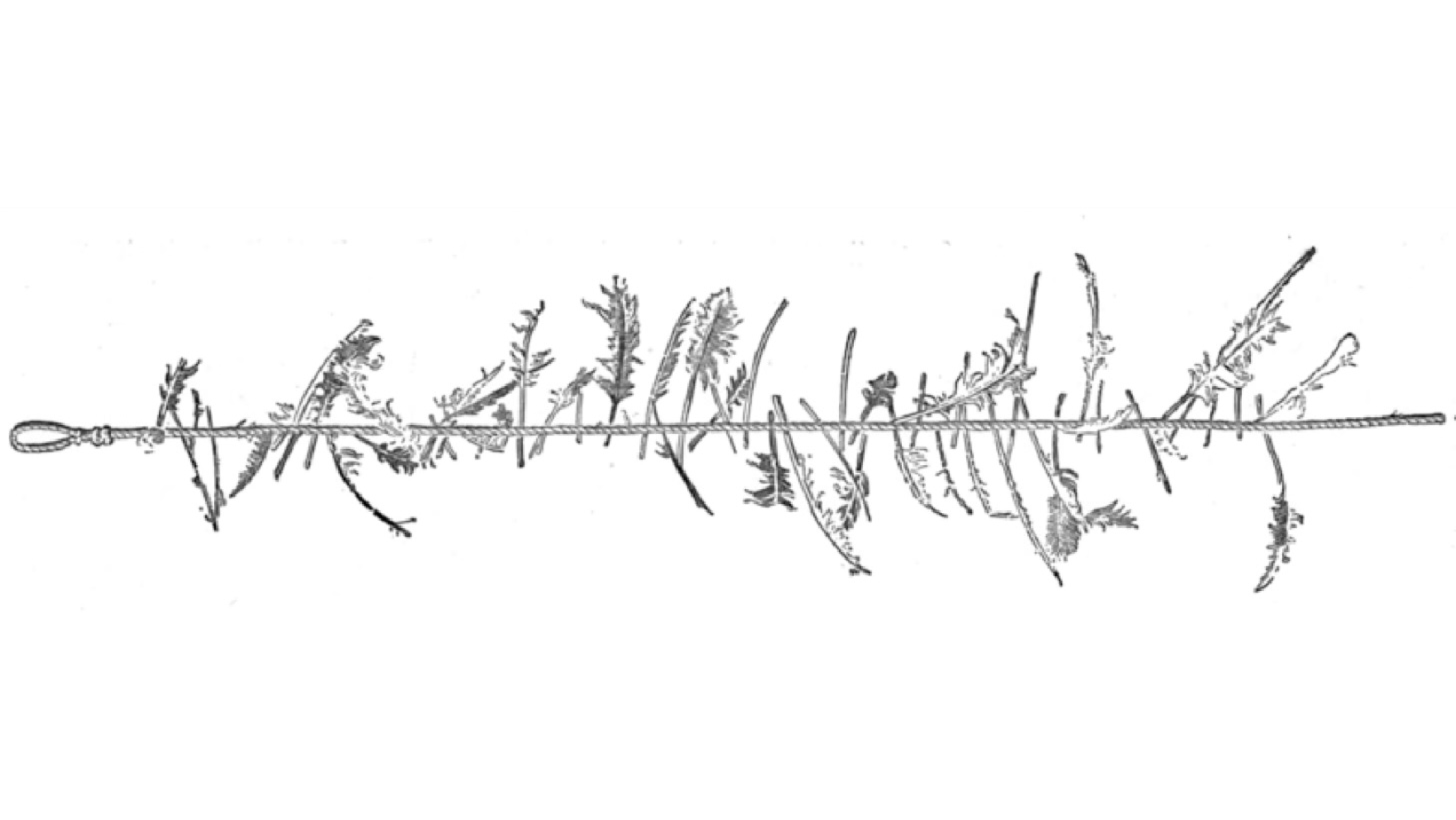
Traditional ladders used knots with feathers attached in binding spells. For instance, to bind an illness the knotted cord was worked up and then thrown into a pond or river–presumably the ailments went with it. [Knotwork is also part of weather magic in Orkney folklore]Any research on the subject is bound (ha!) to turn up the use of knot magic in cursing. We must cast a critical eye on the remnants of history left to us by those who wished to distort our traditions. This work was most likely also used for other benevolent purposes as well as ill. In modern Wicca, the knots are used to seal a working and chanting can be part of it.
A variation on the traditional chant:
Knot one, the work’s begun. Knot two, my aim is true. Knot three, it will be. Knot four, power’s stored. Knot five, the work’s alive. Knot six, the work’s fixed. Knot of seven, the truth given. Knot eight, will be fate. Knot nine, the work is mine
[The currently AI-dominated internet will tell you Deborah Harkness, author of the novel A Discovery of Witches, wrote the worlds of this spell—but I’m here to tell you it it’s older than that.)
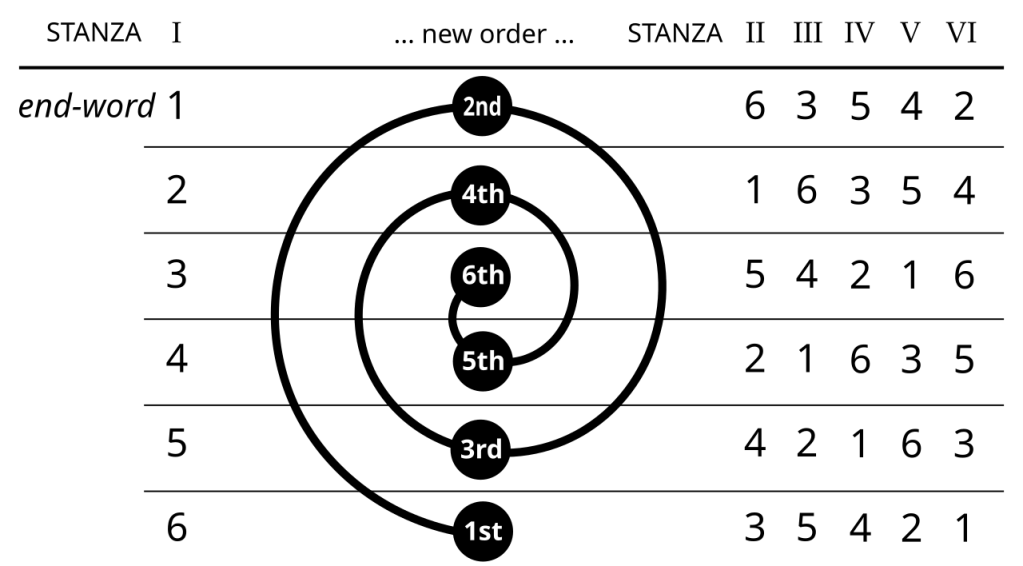
As in prayer and spell work, words are more powerful if you use your own. In my other life as a poet I have been obsessed by the sestina form, a six-stanza poem that ends in a three line envoy. The end words of each line are rotated through the stanzas, as strands in a braid. This form was arguably invented by a 13th century troubadour, Arnaut Daniel, who called it a cledistat, which means “to interlock”. Here is a wonderful graphic that shows the structure of the sestina as a series of beads or knots on a spiral thread.
I am constantly amazed at the correspondences between modes of creative work. The same attention to detail that went into writing my sestinas is manifested in my hand wrapped rosary chains. They are from the heart.
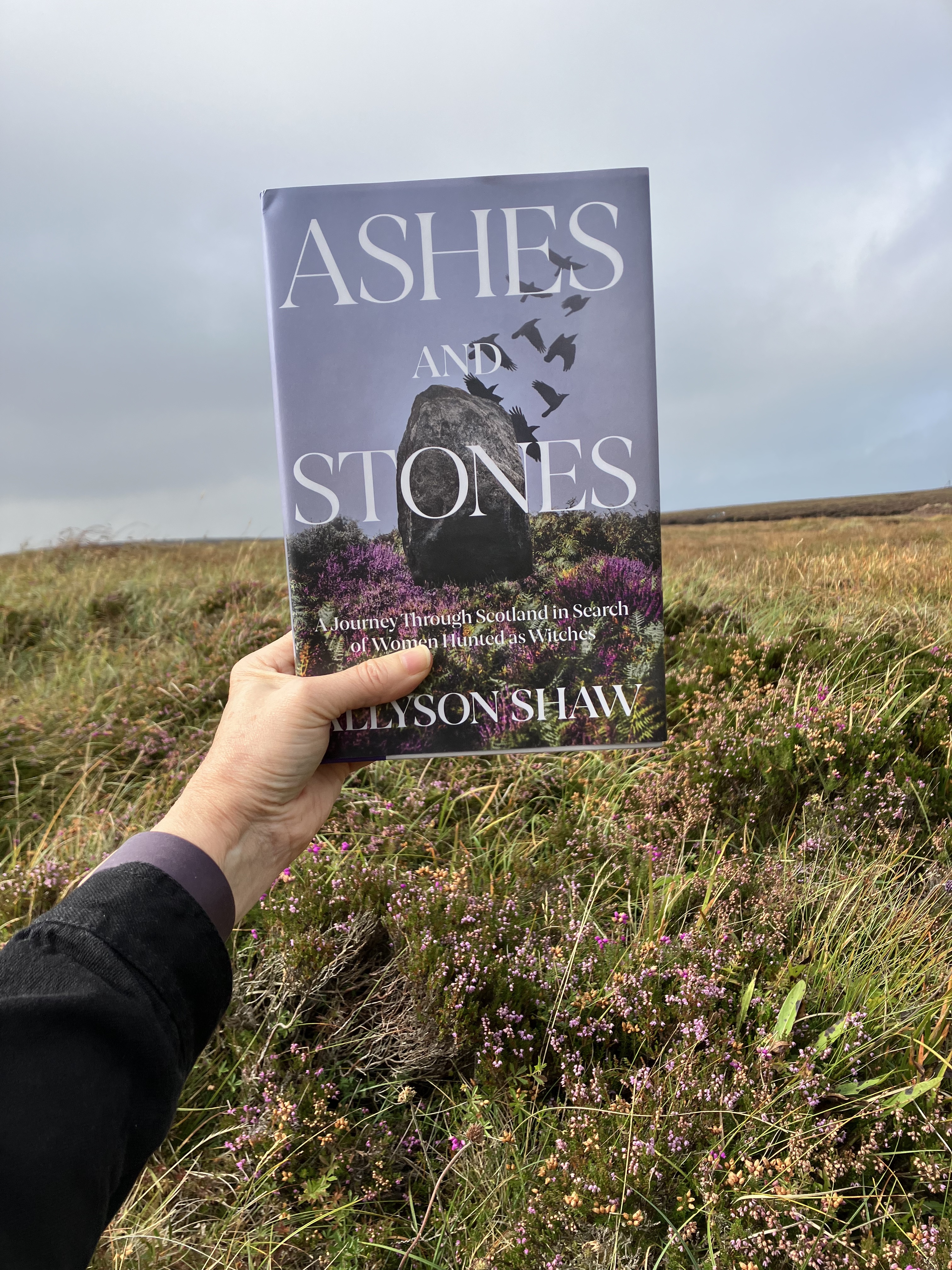
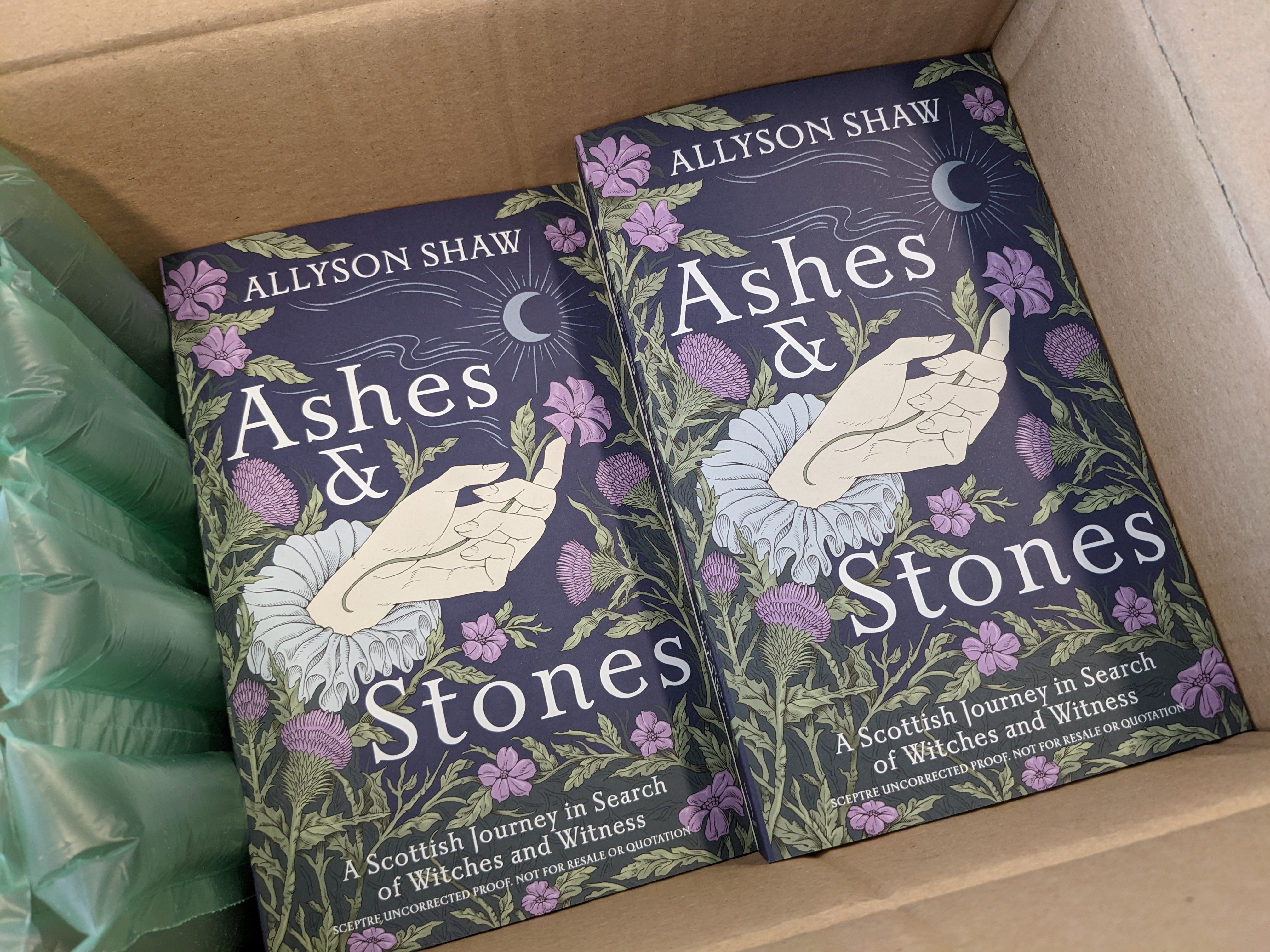
Tomorrow is my book birthday. Ashes & Stones, my creative nonfiction book about women persecuted as witches in Scotland, was published three years ago.
I began writing and researching the book over eight years ago. When I started the work, few people were talking about the history of witch hunts in Scotland, even though #witchythings were riding the capitalist zeitgeist. The witchwave was in full swing, with #instagramwitch influencer culture booming.
Trad publishing is always slow. It comes for trends after they have peaked and are near consumer exhaustion. My book was picked up during the feeding frenzy for witch books.
The sites I mapped and uncovered—sometimes literally—are now well known to Scottish tour guides. Stories uncovered during the countless hours combing through tedious old privy council records and emailing archeologists and other experts are now repeated as if they have always been common knowledge. Social media has made this possible, and we live in a time where citing your sources no longer matters.
I have never had a baby, but writing a book feels like having a baby—except this one gestated for over five years. And then I handed the baby over to strangers to do with it what they will. So maybe it’s not the best analogy.
But let’s go with it. A three year old might be able play with other children, take turns, and understand sharing, but my book came into a world where this isn’t encouraged. I set her on her way into a selfish, antisocial world, to be judged by the money she could make for others rather than for what she was.
Sometimes I still have pangs of grief about that rather than feelings of joyful achievement. BUT she is three! With thousands of readers (tens of thousands, perhaps). She can now also run and jump—into the hands of other readers who have been waiting to find her.
🧁 Celebrate with me. Here are some ideas:
If you are really feeling generous and have read the book, why not leave a review on one of the big sites that collect that kind of thing?
Why not check it out from your library or purchase it? Both of these matter—I get paid when these things happen.
If your library doesn’t have Ashes & Stones, why not request it?
If you know someone who would like my book, tell them about it!
If you are in Scotland, visit one of the sites I mention in the book. Leave a non-material offering. There are too many things littering our sacred sites. Instead, leave a song, words of remembrance or a prayer. If you light a candle, take it with you when you leave.
Also—as the ribbon on top—consider how we consume media. Things are getting tough out there for creatives. I know many of you reading this are in the same boat. Our work is being stolen. Business models that once supported us now turn to influencers to make culture. Our work is disseminated in ways that don’t benefit us, and there is nothing we can do about it. For instance, did you know that authors are not paid (at least not trad published authors) when you read the book on Kindle Unlimited or listen the audio book on Audible or Spotify? Even buying a used copy—great for the environment—means the author sees none of the money changing hands.
revisiting the Janet Horne Memorial Stone on the full moon 🌝
Last month I watched She Will, an impressionistic, feminist horror film about Scottish witches set in the Highlands. Aging film star Veronica Ghent travels to a remote location to convalesce and instead finds herself transformed by the darkness she encounters there.
I missed this film when it came out in 2021, but it’s a cinematic companion to my book about how Scotland remembers the witch hunts. The book is calledAshes & Stones. She Will is a film about memory, femicide and the ‘uses’ of the dead. It is also about confronting past trauma—both personal and historical— while dismantling toxic, predatory masculinity. In the film, as in life, these things happen simultaneously. Yet their relationship remains mysterious in the film: ashes billowing through the air are called ‘witch feathers’ by the locals, and the lore surrounding the land claims the death of women hundreds of years ago gives the earth curative properties.
1940s postcard of the Lairig Ghru Pass in the forest where the film takes place. Printed in Dundee—found on @cornovia_postcards@mstdn.business on Mastodon.
I am intimately familiar with the filming locations of She Will. In the ‘art class scene’ Veronica sits with her easel beside Loch an Eilein in the forest of Rothiemurchus. A boulder inscribed with witch marks lies behind her, off camera. Did the film makers know this? There are legends surrounding the atmospheric, 14th century castle on the island. There was once an underwater, zig-zag causeway linking the island to the shore, though this has never been found. Legend also claims it is the ancestral seat of the Shaw clan in the 14th century—if one believes these things.*
The castle on the island in Loch An Eilein. You could say I was visiting relatives—taken on Christmas Day, 2019
I loved the film’s powerful vision of bonds women share with both the living and dead. It’s also a delicious tale of revenge. I only wished it were longer, and that the character of Desi Hatoum, in a show-stopping performance by Kota Eberhardt, had been given more of a story.
The Janet Horne Memorial Stone in Dornoch is part of the film, transported to a woodland setting. I wrote a piece about the Janet Horne Memorial stone for the Association for Scottish Literature’s online journal, The Bottle Imp in 2019. Did the film makers read it? There is probably no way to know, but I like to think they did.
As part of my research for Ashes & Stones, I repeatedly visited the Janet Horne Memorial Stone. Each time I visited, it was different, surrounded by different tributes that have increased since the book was published. Janet Horne is not the name of the woman who supposedly died near the stone’s present location. Everything we know of her vague story was written down one hundred years after her death, in the notes of English occupiers who wanted to portray Highland Scots as superstitious, backward and unable to rule themselves. She is supposedly the ‘last witch’ executed in Scotland but there is no ‘true story’ of Janet Horne’s life or death, only invention.
In my research I found many photos of the stone through the ages, some from the Dornoch Historical Society and others on the internet without attribution. Here is a gallery.
*This notion is put forth in LOCH AN EILEIN AND ITS CASTLE by Alex Inkson M’Connochie. in The Cairngorm Club Journal 014, 1900.
Have you enjoyed this post? Make a one-time donation!
Choose an amount
£5.00
£10.00
£15.00
Or enter a custom amount
£
Your contribution helps me to keep researching, writing and making work.
The second part of my exploration of Alison Balfour, a woman executed for witchcraft in Orkney, is available here for paid subscribers. I blog regularly for both free and paid subscribers on Substack–join today.
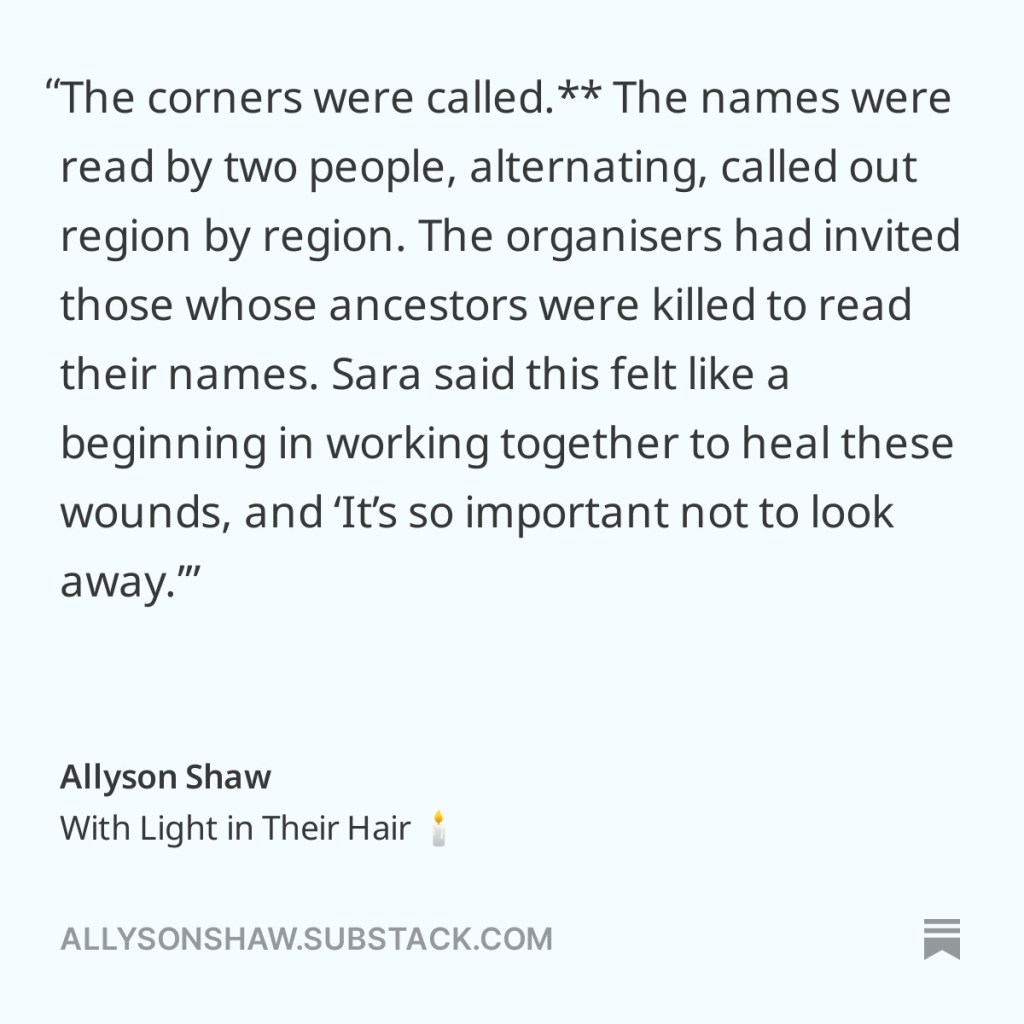
On Dec. 4th a national memorial ceremony was held in Sweden, recognising the suffering of those accused of witchcraft. The power and scale of this, in collaboration with a national institution—The Swedish History Museum. I’ve written about the event, including the voices of those present. It is free to read at my SUBSTACK.
Two years ago I set out a plan to write about the folklore of witchcraft in Orkney and its intersection with the lives of Orcadian women accused of witchcraft. During the witch hunts in Scotland, the people of Orkney were slow to demonise witchcraft and the hunts never reached a full blown panic. There are reasons for this that I might unpack further in another Substack post, but the story of the accused is often eclipsed by legend. Scota Bess on Stronsay is an example of a larger-than-life persona—a mixture of storm witch with elements of a creation goddess. The lived reality of an actual woman named Scota Bess, and indeed any historical record of her life, is seemingly lost to the shadow of her tale. I have written about her for paid subscribers of my Substack.
My obsession with the painter John Atkinson Grimshaw is rekindled by the mouldy prints of his work hanging in an abandoned croft on Stronsay. Shipwrecks, mermaid chairs, selkie songs and seal culls…The final instalment of my Stronsay field notes is free to read at my Substack.
My latest Substack post is the beginning of a series of irregular long reads for paid subscribers of my Substack—sketches for a book I thought I might write about Orcadian women accused of witchcraft.
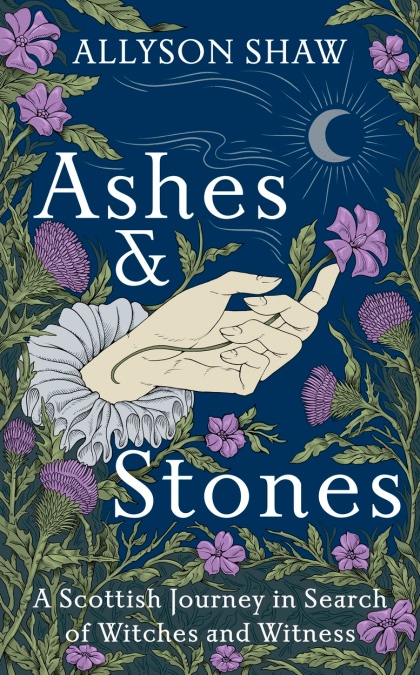
I’m so pleased to share the gorgeous cover design for Ashes and Stones by Natalie Chen. The illustrator is Iain MacArthur.
‘It’s summer. I stand where perhaps Ellen stood, in this ground thick with new thistle and long grass. She would have ken this coast in all weathers: in the summer when it was as gentle as a lake and in the winter, with the high winds and stinging salt spray.’
Ashes and Stones is a moving and personal journey, along rugged coasts and through remote villages and modern cities, in search of the traces of those accused of witchcraft in seventeenth-century Scotland. We visit modern memorials, roadside shrines and standing stones, and roam among forests and hedge mazes, folk lore and political fantasies. From fairy hills to forgotten caves, we explore a spellbound landscape.