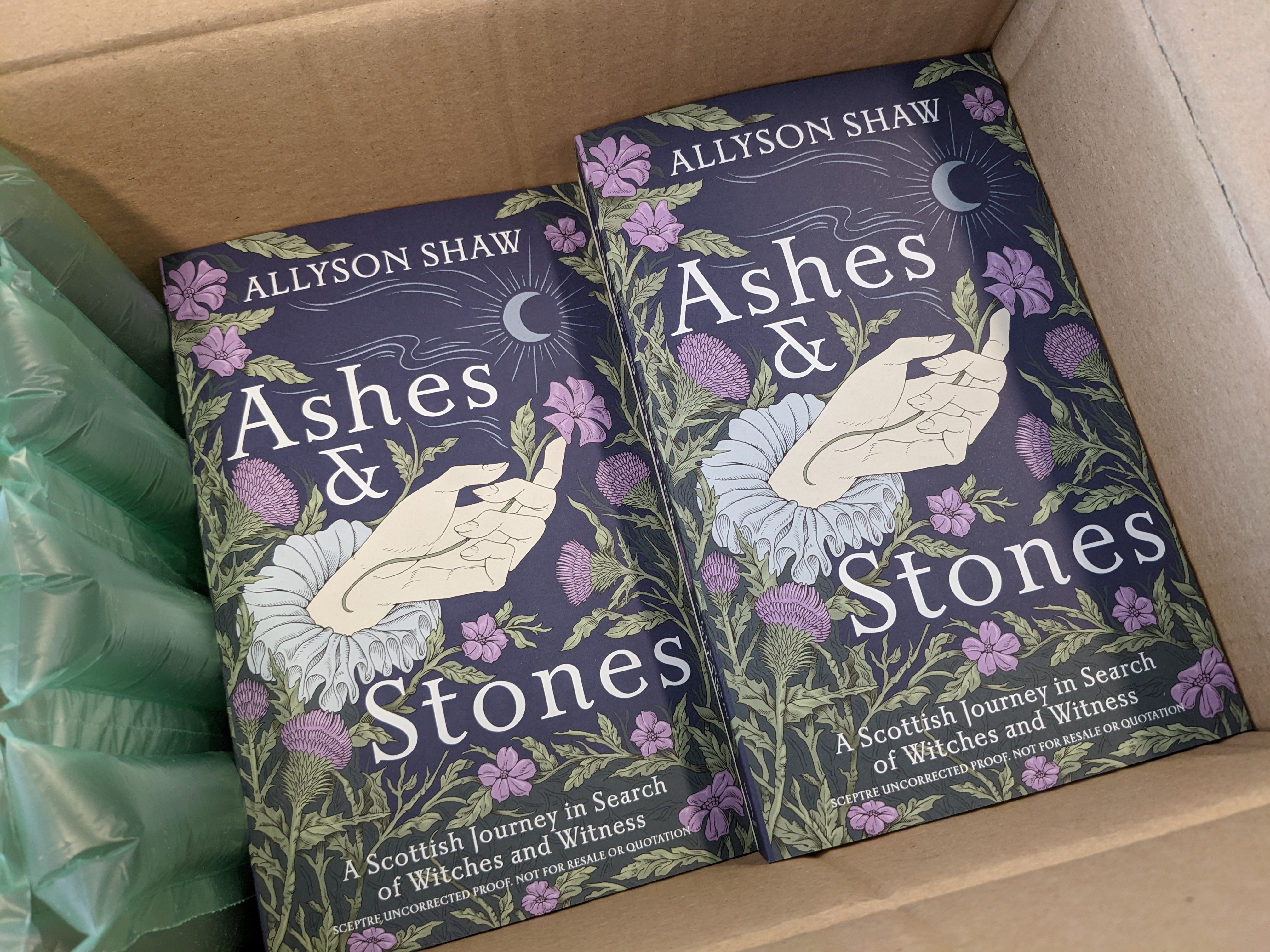
Tomorrow is my book birthday. Ashes & Stones, my creative nonfiction book about women persecuted as witches in Scotland, was published three years ago.
I began writing and researching the book over eight years ago. When I started the work, few people were talking about the history of witch hunts in Scotland, even though #witchythings were riding the capitalist zeitgeist. The witchwave was in full swing, with #instagramwitch influencer culture booming.
Trad publishing is always slow. It comes for trends after they have peaked and are near consumer exhaustion. My book was picked up during the feeding frenzy for witch books.
The sites I mapped and uncovered—sometimes literally—are now well known to Scottish tour guides. Stories uncovered during the countless hours combing through tedious old privy council records and emailing archeologists and other experts are now repeated as if they have always been common knowledge. Social media has made this possible, and we live in a time where citing your sources no longer matters.
I have never had a baby, but writing a book feels like having a baby—except this one gestated for over five years. And then I handed the baby over to strangers to do with it what they will. So maybe it’s not the best analogy.
But let’s go with it. A three year old might be able play with other children, take turns, and understand sharing, but my book came into a world where this isn’t encouraged. I set her on her way into a selfish, antisocial world, to be judged by the money she could make for others rather than for what she was.
Sometimes I still have pangs of grief about that rather than feelings of joyful achievement. BUT she is three! With thousands of readers (tens of thousands, perhaps). She can now also run and jump—into the hands of other readers who have been waiting to find her.
🧁 Celebrate with me. Here are some ideas:
If you are really feeling generous and have read the book, why not leave a review on one of the big sites that collect that kind of thing?
Why not check it out from your library or purchase it? Both of these matter—I get paid when these things happen.
If your library doesn’t have Ashes & Stones, why not request it?
If you know someone who would like my book, tell them about it!
If you are in Scotland, visit one of the sites I mention in the book. Leave a non-material offering. There are too many things littering our sacred sites. Instead, leave a song, words of remembrance or a prayer. If you light a candle, take it with you when you leave.
Also—as the ribbon on top—consider how we consume media. Things are getting tough out there for creatives. I know many of you reading this are in the same boat. Our work is being stolen. Business models that once supported us now turn to influencers to make culture. Our work is disseminated in ways that don’t benefit us, and there is nothing we can do about it. For instance, did you know that authors are not paid (at least not trad published authors) when you read the book on Kindle Unlimited or listen the audio book on Audible or Spotify? Even buying a used copy—great for the environment—means the author sees none of the money changing hands.
I have always wrestled with the Witch Wave with its algorithmic intensity. Its illusion-filled manipulations crowd my feeds, noisy with competitive bristle. It feels crowded here.
Over a decade ago I took photos of my altar to share with other witches on Instagram. They never went viral, never hit any sort of algorithmic payload because there wasn’t one. I knew who I was talking to and why. And then one day someone I didn’t know (what we now call a ‘Random Reply Guy’) commented that to post any magical tool or altar online was to drain it of its power.
What if they were right?
I now question my impulse to document things that are sacred to me. I wonder who is it for? That witchy community is gone. Perhaps some are still on instagram, thrown to the algorithmic winds where I will never see them. There are countless practitioners plying their trades on Substack and Instagram. Witchy life coaches, psychics, tarot readers and astrologers. I don’t need these services. I am not their potential customer. Are we building community or a customer/fan base?
In times like these, Hillary Mantel’s Beyond Black feels relevant. A book about psychic grift, trauma & bona fide hauntings, it’s extremely dark—no love and light here, sorry. And yet it’s witchy, powerful and unlike anything I’ve ever read. Mantel’s memoirGiving Up the Ghost is equally haunted but much lighter.
In these moments bereft of ‘audience’—I think of Hillary Mantel, a writer who saw ghosts. Her ability to write about liminality while surviving her chronic illness is nothing less than magical. She would never have called herself a witch. It was not her intention to bring ‘magic’ into the world; she did it anyway.
A year ago I wrote about the New Age Witch Grift here—many of the same themes still dog this blog!
The Altar I Did Not Photograph
This time of year, Orkney is thronged with tourists travelling in packs, eating ice creams and taking photos. Cruise ships—those floating hotels—park in the sea outside Kirkwall, and little boats ferry wealthy tourists back and forth. They circle around the same places and then leave, replaced the next day by others doing the same thing.
It feels crowded here.
Avoiding the hoards is an art. The gloaming has become my friend. The paths less travelled, to misquote Frost, have made all the difference. Last week I was in Birsay and tour buses were parked on the narrow road, depositing crowds at the Earl’s Palace ruins.
Not far off the main road, a path winds seaward. Rabbits in the hundreds run over the low dunes, the tufts of their tails flashing white. Entrances to their warrens—myriad liminal doorways—riddle the path. One must step carefully over them.
A pod of seals lounges on the rocks below, some in a yogic ‘banana’ pose. A little pup swims in the shallows, watching me.
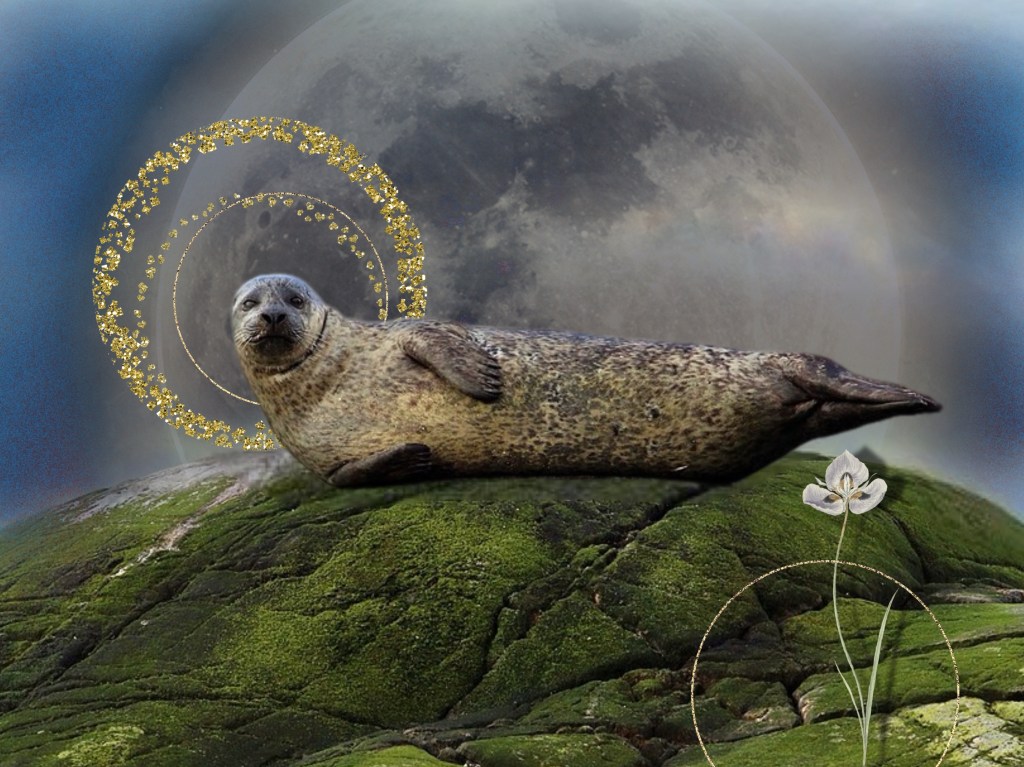
I see selkies all the time. They show up when I am most despairing. Seal medicine. If I take it, I must accept a responsibility in the exchange. They must remain unmolested by me, by us.
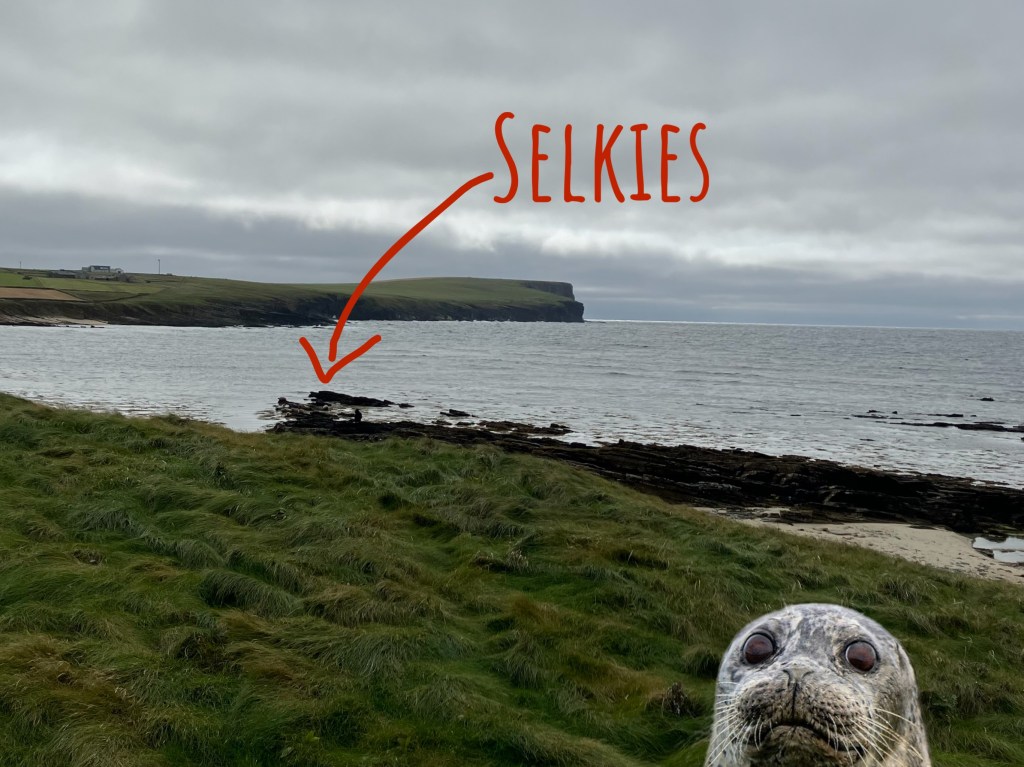
On the path leading to the headland, I use my monocular to get a good look at the selkies. I can’t get too close—won’t capture them with my phone camera. The pact I have with these beings is one of distance and silence.
Can you see them?
In other news, the Big Frog in my garden has been joined by a baby frog. I have no photos of this good omen. What good omens have graced you recently?
Two years ago I set out a plan to write about the folklore of witchcraft in Orkney and its intersection with the lives of Orcadian women accused of witchcraft. During the witch hunts in Scotland, the people of Orkney were slow to demonise witchcraft and the hunts never reached a full blown panic. There are reasons for this that I might unpack further in another post, but the story of the accused is often eclipsed by legend. Scota Bess on Stronsay is an example of a larger-than-life persona—a mixture of storm witch with elements of a creation goddess. The lived reality of an actual woman named Scota Bess, and indeed any historical record of her life, is seemingly lost to the shadow of her tale.
I am at St. Combs, a fishing village and beach named after the Pictish saint Columba. I was inspired by Sally Huband’s extraordinary book about beach combing, Sea Bean. I revisited this old pastime, something I did a lot when I first moved to Northeast Scotland. I scan the sand and sha…
Before moving to Scotland, I was learning what I now call hedgewitchery, riding of metaphysical hedges using trance-work commonly referred to as shamanic journeying. In one journey I was given a piglet to hold and care for. That piglet changed my life. It was not long after this that I found the house in Banff in the Northeast of Scotland where I would write Ashes & Stones.
Piglet or Holy Woman?
The house in Banff was literally a leap of faith—into a new landscape with a history and different languages—Scots and Gaelic—with Doric dialect thrown in the mix. The etymology of the name Banff is contested. Is it derived from the Scottish Gaelic banbh meaning ‘piglet’ or is it a contraction of bean-naomh, Gaelic for ‘holy woman’?
Dolphins—those misunderstood, exploited people of the sea—are at the centre of this question. They are often spotted off the coastline at Banff, and all along the Northeast coast, dolphins are joyful part of the seascape. In 17th-18th century Scots, a mereswyne—sea pig—was a porpoise or dolphin.
Etymological name-puzzles carry over to Orkney, where I now live.
I am piglet, dragon, cetacean, and woman. What am I?
Orkney was known to Ptolemy and the Venerable Bede as Orcades, after the Latin orca meaning whale. (There are a lot of Orcas around Orkney.)
Before 16th century Scots mereswyne, Old English had mereswīn or porpoise. This linguistic link goes back farther still. Before early Modern Scots, before Old English and even before the Norse settlers, there were Iron Age Picts in Orkney called the Orcs. Little remains of their presence save a few expertly carved stones and their name. Orc is a Pictish tribal name meaning young pig. The 9th century Norse settlers met the Picts and either assimilated or destroyed them—no one knows. The settlers saw in the local tribal name Orc their word for seal—orkn. They reinterpreted the name and added eyjar, orislands, to make Orkneyjar—Seal Islands. (There are a lot of seals around Orkney, also.)
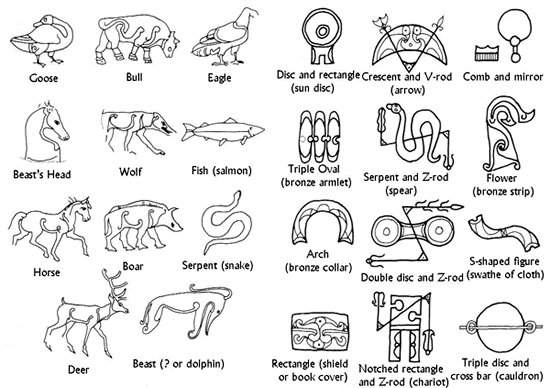
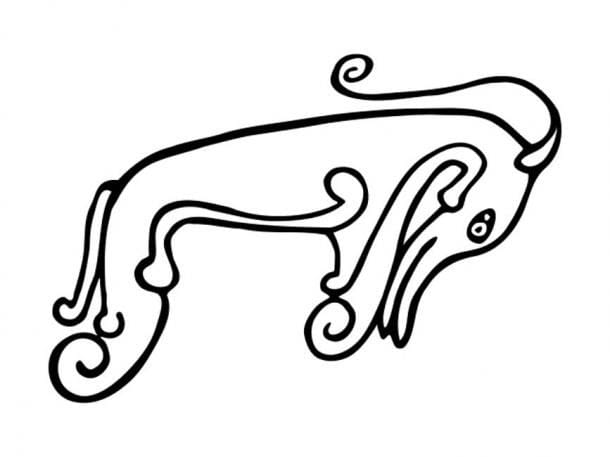
The Picts left elaborately carved stones all over Scotland, and some were re-carved with beautiful crosses as they converted to Christianity. The earlier symbols like the crescent and Z rod defy modern understanding, but the animal portraits on the stones show a keen intimacy with the being portrayed—an understanding of the anatomy and movement, of the animal’s presence. The beings on the stones are representations of animals we know today: eagles, boars, deer, bulls, salmon, serpents, bears and others. There’s one exception to this earthly menagerie—the mysterious Pictish ‘beast’. This dragon-like figure is most common on Pictish stones in Northeast Scotland.
Stylised Pictish Beast–Struthious Bandersnatch via wikimedia commons
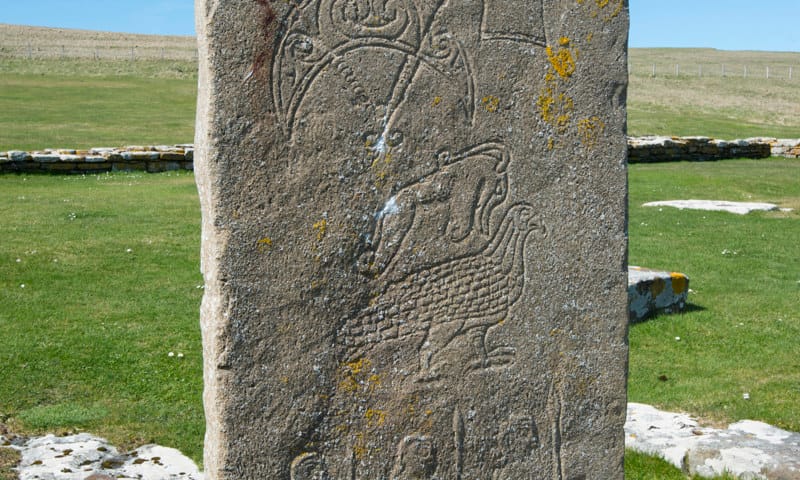
These stones are rare in Orkney and the Pictish beast is rarer still. In 2016 a violent storm revealed an 8th century Pictish stone wedged in a cliff face in Deerness on the east Mainland. On one side is an elaborately carved Celtic cross, with a Pictish beast on the other.
Reproduction of the Pictish Stone on Birsay via the Visit Orkney Website
A second Pictish beast was found on a stone on the tidal island of Birsay, carved above another totemic Orkney animal—the sea eagle. Some have argued that the beast is a dragon or kelpie (a water-horse in Scottish folklore), but others see the beast as a dolphin—and I’m inclined to agree.
Marioun
Marioun Pardoun (also named Peblis and Peebles in the record) was executed for the crime of witchcraft in Scalloway in Shetland on the 22nd of March, 1644. She was accused of magically overturning a boat, causing four men to drown. When the bodies were found, Marioun and her husband were required to put their hands on the corpses to determine their innocence. The bodies bled and, in the logic of the time, this proved her guilt. (There is no mention of the husband in the trial record except in Marioun’s tortured reverie.) Details of her ‘waking’ or sleep deprivation were recorded, and her torturers are named—Mans Finlaysone and Jon Erasmussone. The greater the pressure they put on her, the more incoherent her confession became.
(I translate these words from Helene Willumsen’s transcription of the trial record into contemporary diction.) ‘…when they were waking her she asked where was the husband who was answering her? Speaking concerning her husband, she answered [that] he lay under her head and would not suffer her to confess.’ An accusation is noted in the margin of the trial record: Clothing your spirit with said pellock quaill. A pellock quaill is a dolphin.
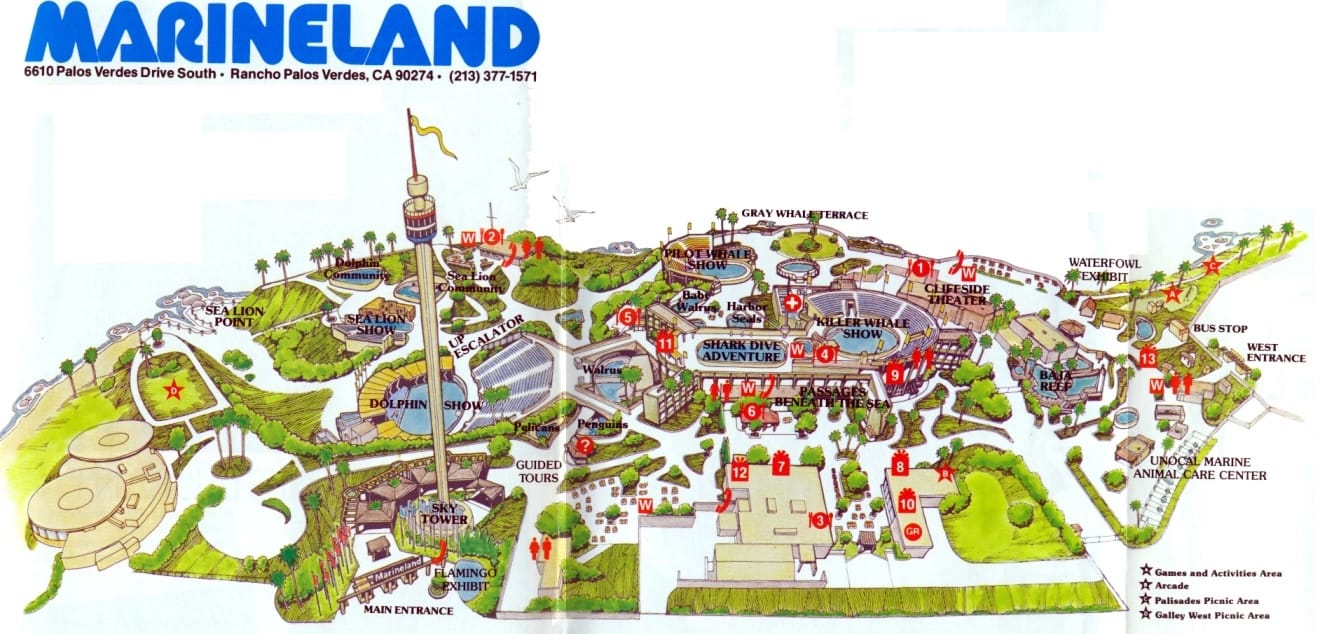
A map of the water circus Marineland in the 1980s
Captive
When I was a child I liked to listen to whale and dolphin sounds. I loved their throat songs—the clicking giggles, whistles of joy and foreboding above bass drop of deep water. I had a flexidisc from an issue of National Geographic that I played over and over on my portable turntable. When we moved from the midwest to Southern California, my father took me to Marineland to see some dolphins. It was 1986, a year before the grim place would close for good. Years after my visit, it remained a ruined, graffittied site used by locals as a makeshift skate park until it was developed into a resort. All of this is now sinking into the sea, including the 18th hole at the adjacent Trump golf course. Nostalgic, surreal reveries on Reddit are my only corroborators, with one poster using the phrase ‘fever dream’ to describe their memories of late 80s Marineland. It was once the world’s largest water circus, housing captive dolphins, orcas and seals. Orcas and pilot whales were forced to perform in tiny tanks—their lives often short and tortured. Dolphins leapt through hoops of fire and sea lions were forced to ‘sing’.
In my recollection, only my father and I are there, standing in wonder before the green murk of the empty ‘shark experience’ tank. We meander through the sun bleached park, around show tanks, their artificial blue depths mirror-still, as if before a storm. I stand alone beside the ‘Dolphin Community Tank’ and a being surfaces. She breathes. I put my hand out and touch the pale grey slip of her forehead. She looks at me and I am in the presence of a spirit clothed with pellock quaill. Her black eye takes me in–looks past to all beyond—over the walls of the park to the wide, bright sea.
Further explorations
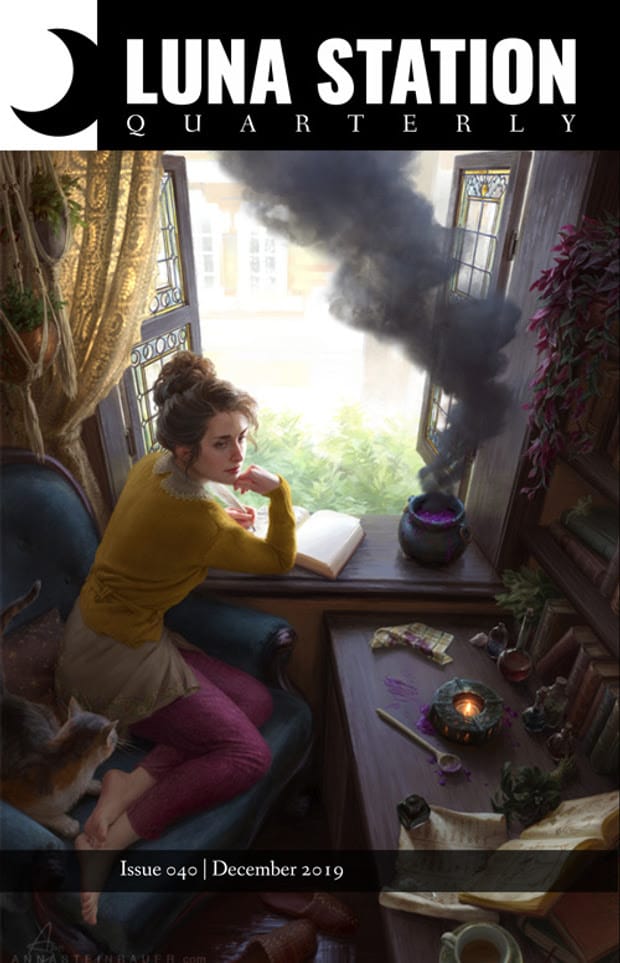
—Tales of Pictish beasts and dolphin transformations inspired my short story, ‘Gald.’ A chance meeting in a post apocalyptic Aberdeenshire changes two young women’s lives forever. You can read it in Luna Station Quarterly, issue 40—available as a paperback and ebook: https://www.lunastationquarterly.com/issues/040/
—Take a stand against the horrific slaughter of whole pods of pilot whales and dolphins in the annual Grindadráp hunt in the Faroe Islands. Just this month, 291 pilot whales were slaughteredin the village of Leynar, including pregnant females and juveniles.Boycott tourism to the Faroe Islands and encourage others to do so. Put pressure on the Faroe Islands government to put an end to this cruel ‘tradition’ that threatens the future of the pilot whale. Find out more here (warning–this link shows footage of the hunt and contains the graphic and violent animal cruelty of the hunt.) https://seashepherd.org/faroeislands/. If you would like to take action without seeing these images, go to this page to write to officials directly.
—Dolphin photographer with the Whale and Dolphin conservation society Charlie Philips regularly records and posts beautiful images of Dolphins from the Moray Firth on Mastodon
—Laline Paul’s brilliant Pod will haunt you eternally.
revisiting the Janet Horne Memorial Stone on the full moon 🌝
Last month I watched She Will, an impressionistic, feminist horror film about Scottish witches set in the Highlands. Aging film star Veronica Ghent travels to a remote location to convalesce and instead finds herself transformed by the darkness she encounters there.
I missed this film when it came out in 2021, but it’s a cinematic companion to my book about how Scotland remembers the witch hunts. The book is calledAshes & Stones. She Will is a film about memory, femicide and the ‘uses’ of the dead. It is also about confronting past trauma—both personal and historical— while dismantling toxic, predatory masculinity. In the film, as in life, these things happen simultaneously. Yet their relationship remains mysterious in the film: ashes billowing through the air are called ‘witch feathers’ by the locals, and the lore surrounding the land claims the death of women hundreds of years ago gives the earth curative properties.
1940s postcard of the Lairig Ghru Pass in the forest where the film takes place. Printed in Dundee—found on @cornovia_postcards@mstdn.business on Mastodon.
I am intimately familiar with the filming locations of She Will. In the ‘art class scene’ Veronica sits with her easel beside Loch an Eilein in the forest of Rothiemurchus. A boulder inscribed with witch marks lies behind her, off camera. Did the film makers know this? There are legends surrounding the atmospheric, 14th century castle on the island. There was once an underwater, zig-zag causeway linking the island to the shore, though this has never been found. Legend also claims it is the ancestral seat of the Shaw clan in the 14th century—if one believes these things.*
The castle on the island in Loch An Eilein. You could say I was visiting relatives—taken on Christmas Day, 2019
I loved the film’s powerful vision of bonds women share with both the living and dead. It’s also a delicious tale of revenge. I only wished it were longer, and that the character of Desi Hatoum, in a show-stopping performance by Kota Eberhardt, had been given more of a story.
The Janet Horne Memorial Stone in Dornoch is part of the film, transported to a woodland setting. I wrote a piece about the Janet Horne Memorial stone for the Association for Scottish Literature’s online journal, The Bottle Imp in 2019. Did the film makers read it? There is probably no way to know, but I like to think they did.
As part of my research for Ashes & Stones, I repeatedly visited the Janet Horne Memorial Stone. Each time I visited, it was different, surrounded by different tributes that have increased since the book was published. Janet Horne is not the name of the woman who supposedly died near the stone’s present location. Everything we know of her vague story was written down one hundred years after her death, in the notes of English occupiers who wanted to portray Highland Scots as superstitious, backward and unable to rule themselves. She is supposedly the ‘last witch’ executed in Scotland but there is no ‘true story’ of Janet Horne’s life or death, only invention.
In my research I found many photos of the stone through the ages, some from the Dornoch Historical Society and others on the internet without attribution. Here is a gallery.
*This notion is put forth in LOCH AN EILEIN AND ITS CASTLE by Alex Inkson M’Connochie. in The Cairngorm Club Journal 014, 1900.
Have you enjoyed this post? Make a one-time donation!
Choose an amount
£5.00
£10.00
£15.00
Or enter a custom amount
£
Your contribution helps me to keep researching, writing and making work.
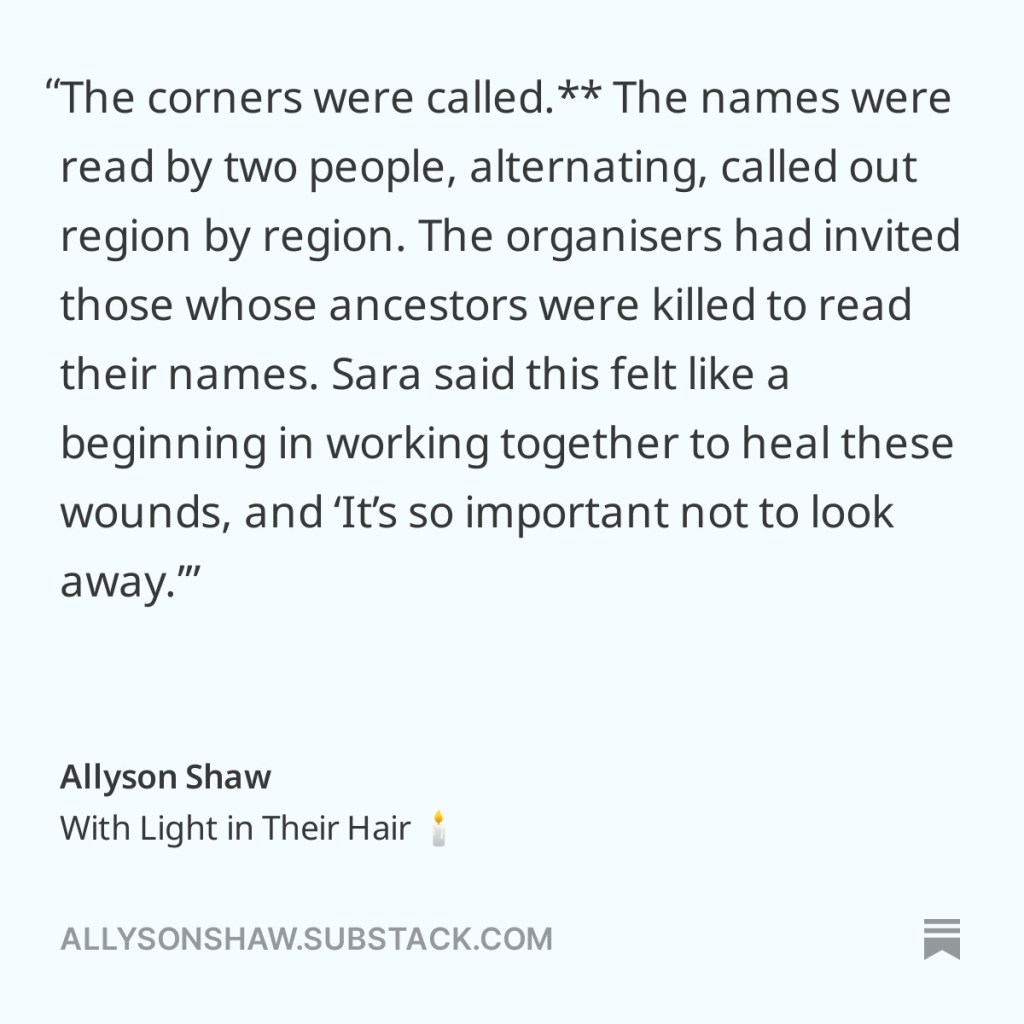
On Dec. 4th a national memorial ceremony was held in Sweden, recognising the suffering of those accused of witchcraft. The power and scale of this, in collaboration with a national institution—The Swedish History Museum. I’ve written about the event, including the voices of those present. It is free to read at my SUBSTACK.
“…wintering out/ the back end of a bad year…” -Seamus Heaney, “Servant Boy”
🪨 🌚 🪨 🥃 🪨 🕯️🪨
It’s said that on Hogmanay the Stones of Stenness walk to the loch of Harray for a drink—yet none have witnessed this—perhaps until now…
The first instalment of my field notes on Stenness is up at my Substack. I explore the accused witch Alison Balfour’s relationship to what is now known as the Heart of Neolithic Orkney. This one is for paid subscribers! Become a paid subsciber to read all my Orkney field notes. 📸 Image is a picture I took of the Stones in the snow last January, 2023.
Every month I share a curated list of what I’m reading, watching, listening to and thinking about with my newsletter subscribers. Read the latest, all about Yuletide Ghost stories—with a brief mention of the extraordinary ceremony held in Sweden this month to remember those persecuted for witchcraft. Find out more at r Rebecca Tiger’s Instagram. (more on this soon.)
Two years ago I set out a plan to write about the folklore of witchcraft in Orkney and its intersection with the lives of Orcadian women accused of witchcraft. During the witch hunts in Scotland, the people of Orkney were slow to demonise witchcraft and the hunts never reached a full blown panic. There are reasons for this that I might unpack further in another Substack post, but the story of the accused is often eclipsed by legend. Scota Bess on Stronsay is an example of a larger-than-life persona—a mixture of storm witch with elements of a creation goddess. The lived reality of an actual woman named Scota Bess, and indeed any historical record of her life, is seemingly lost to the shadow of her tale. I have written about her for paid subscribers of my Substack.
My obsession with the painter John Atkinson Grimshaw is rekindled by the mouldy prints of his work hanging in an abandoned croft on Stronsay. Shipwrecks, mermaid chairs, selkie songs and seal culls…The final instalment of my Stronsay field notes is free to read at my Substack.
My latest Substack post is the beginning of a series of irregular long reads for paid subscribers of my Substack—sketches for a book I thought I might write about Orcadian women accused of witchcraft.





 Allyson Shaw, Author of Ashes and Stones