On Selkies & Silence

In This Missive:

  • Witch Grift & Sacred Secrets
  • The Altar I Did Not Photograph
  • Other Posts about Selkies

I have always wrestled with the Witch Wave with its algorithmic intensity. Its illusion-filled manipulations crowd my feeds, noisy with competitive bristle. It feels crowded here.

Over a decade ago I took photos of my altar to share with other witches on Instagram. They never went viral, never hit any sort of algorithmic payload because there wasn’t one. I knew who I was talking to and why. And then one day someone I didn’t know (what we now call a ‘Random Reply Guy’) commented that to post any magical tool or altar online was to drain it of its power.

What if they were right?

I now question my impulse to document things that are sacred to me. I wonder who is it for? That witchy community is gone. Perhaps some are still on instagram, thrown to the algorithmic winds where I will never see them. There are countless practitioners plying their trades on Substack and Instagram. Witchy life coaches, psychics, tarot readers and astrologers. I don’t need these services. I am not their potential customer. Are we building community or a customer/fan base?

In times like these, Hillary Mantel’s Beyond Black feels relevant. A book about psychic grift, trauma & bona fide hauntings, it’s extremely dark—no love and light here, sorry. And yet it’s witchy, powerful and unlike anything I’ve ever read. Mantel’s memoir Giving Up the Ghost is equally haunted but much lighter.

In these moments bereft of ‘audience’—I think of Hillary Mantel, a writer who saw ghosts. Her ability to write about liminality while surviving her chronic illness is nothing less than magical. She would never have called herself a witch. It was not her intention to bring ‘magic’ into the world; she did it anyway.

A year ago I wrote about the New Age Witch Grift here—many of the same themes still dog this blog!


The Altar I Did Not Photograph

This time of year, Orkney is thronged with tourists travelling in packs, eating ice creams and taking photos. Cruise ships—those floating hotels—park in the sea outside Kirkwall, and little boats ferry wealthy tourists back and forth. They circle around the same places and then leave, replaced the next day by others doing the same thing.

It feels crowded here.

Avoiding the hoards is an art. The gloaming has become my friend. The paths less travelled, to misquote Frost, have made all the difference. Last week I was in Birsay and tour buses were parked on the narrow road, depositing crowds at the Earl’s Palace ruins.

Not far off the main road, a path winds seaward. Rabbits in the hundreds run over the low dunes, the tufts of their tails flashing white. Entrances to their warrens—myriad liminal doorways—riddle the path. One must step carefully over them.

A pod of seals lounges on the rocks below, some in a yogic ‘banana’ pose. A little pup swims in the shallows, watching me.

I see selkies all the time. They show up when I am most despairing. Seal medicine. If I take it, I must accept a responsibility in the exchange. They must remain unmolested by me, by us.

On the path leading to the headland, I use my monocular to get a good look at the selkies. I can’t get too close—won’t capture them with my phone camera. The pact I have with these beings is one of distance and silence.
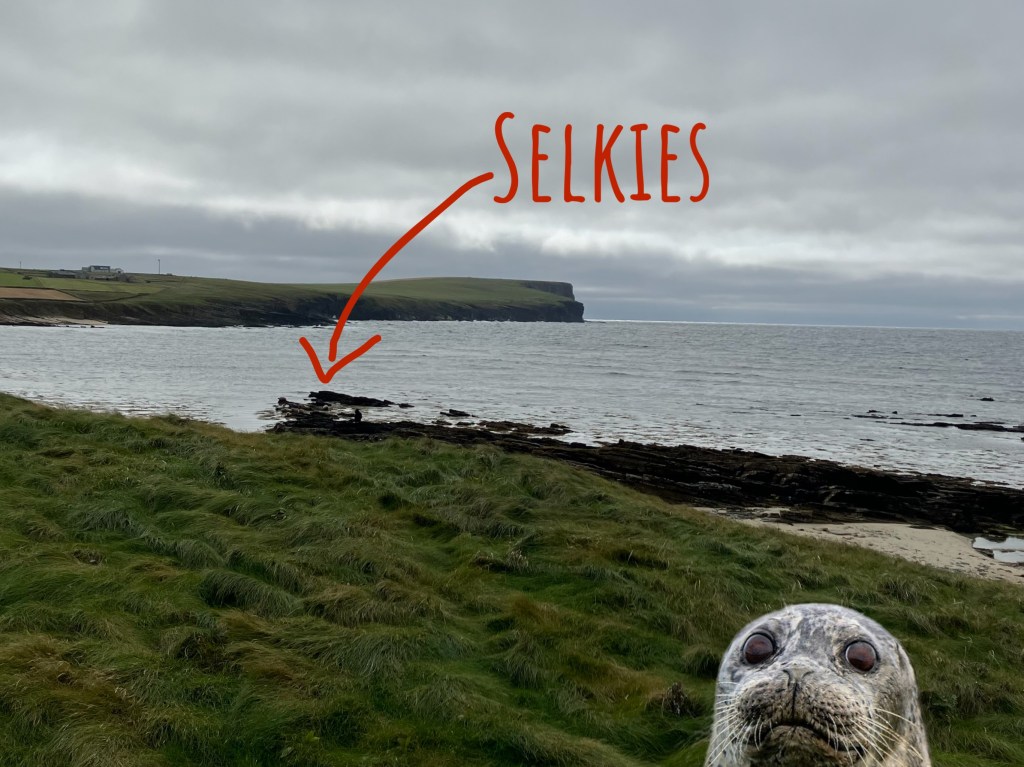
Can you see them?

In other news, the Big Frog in my garden has been joined by a baby frog. I have no photos of this good omen. What good omens have graced you recently?

Other posts on Selkies:

THESE THINGS I HALF BELIEVE 🦭

1 November 2024

Two years ago I set out a plan to write about the folklore of witchcraft in Orkney and its intersection with the lives of Orcadian women accused of witchcraft. During the witch hunts in Scotland, the people of Orkney were slow to demonise witchcraft and the hunts never reached a full blown panic. There are reasons for this that I might unpack further in another post, but the story of the accused is often eclipsed by legend. Scota Bess on Stronsay is an example of a larger-than-life persona—a mixture of storm witch with elements of a creation goddess. The lived reality of an actual woman named Scota Bess, and indeed any historical record of her life, is seemingly lost to the shadow of her tale.

Read full story

SELKIE

·20 April 2023

I am at St. Combs, a fishing village and beach named after the Pictish saint Columba. I was inspired by Sally Huband’s extraordinary book about beach combing, Sea Bean. I revisited this old pastime, something I did a lot when I first moved to Northeast Scotland. I scan the sand and sha…

Read full story

Seeded Memory: What the body knows

A WANING MOON ROUND UP 🌱🌘

Old photo of a Finnish Sauna from The Daily Scandinavian
  • Musing on: What the body knows about liberation
  • Reading: The Memory Police by Yoko Ogawa
  • Listening To: Fiona Soe Paing’s Sand, Silt, Flint
  • Watching: Sweat Sauna Sisterhood
  • Planning: A Vernal Outlier Hour

Musing On: liberation & what the body knows

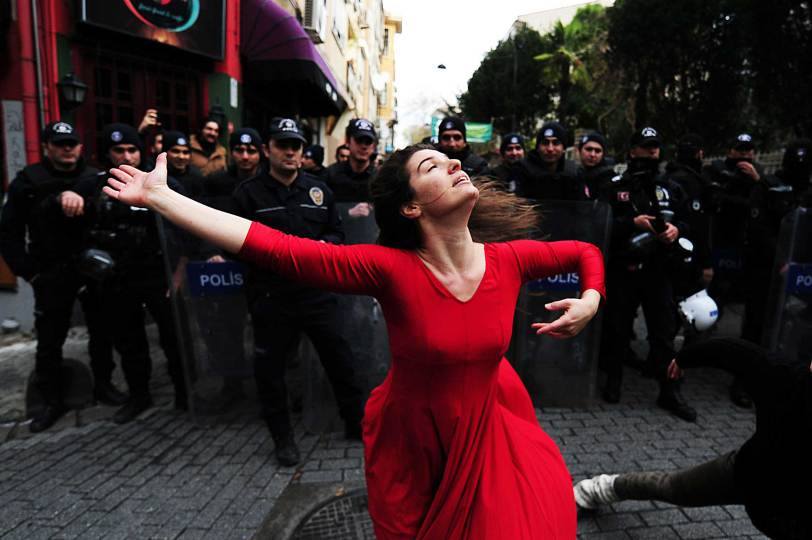
A woman dances in front of riot police during a demonstration in the Kadikoy neighborhood of Istanbul against the eviction of a squatted building. 2014 (Photograph by Ozan Kose—AFP/Getty Images) From Time’s FB page

Twenty years ago I wrote a novel about rebellion in a world dominated by AI. Much of the subversion took place in the character’s bodies, in their resistance to invasive tech. In the opening scene, a cadre of dancing women confront riot police. This novel wasn’t published, but it’s message seems almost prophetic now.

Climate change, dystopias and looming apocalypse are our shared reality. If we are to write anything hopeful or subversive, we must start where we are—without denying the darkness—and see beyond it. This way of seeing is felt, danced and wept into being. It is somatic. To know it, we must return to the body as a teacher. In Silvia Federici’s essay, In Praise of the Dancing Body, she sets out her argument that the body is a site of resistance:

,,,the body as a ground of resistance, that is the body and its powers – the power to act, to transform itself and the world and the body as a natural limit to exploitation.

Federici’s Caliban and the Witch had a deep influence on my historical analysis in my book about the Scottish witch hunts, Ashes & Stones. The 16th-17th century saw vast privatisation of public land, and this coincided with the witch hunts in Europe.

Capitalism was born from the separation of people from the land and its first task was to make work independent of the seasons and to lengthen the workday beyond the limits of our endurance. —Silvia Federici

We now see another vast privatisation of public and personal space—our shared online lives. Friendships and communities are now manipulated and distorted by insatiable capitalists. Creative work of artists and writers is fed to generative plagiarism machines, regurgitated in endless permutations of soulless productivity.

Some of us remember the early days of the internets; INFORMATION WANTS TO BE FREE was the rallying cry of DIY coders and archivists.

That is still true, but we are up against mighty foes.

I first heard about Federici’s essay in In SEÁN PÁDRAIG O’DONOGHUE‘s recent writings about techbros and psychedelics, The Techbros vs. The Elders of the Earth. This essay is a must-read for our present moment.

What does the body have to do with this? I have often turned to my own body for its wealth of somatic knowledge—as a dancer, spirit worker, and someone who must harness chronic pain as a teacher.

In pre-capitalist societies people thought they had the power to fly, to have out-of body experiences, to communicate, to speak with animals and take on their powers and even shape-shift. —Silvia Federici

A sense of loss persisted as I wrote Ashes & Stones, not only of individual lives but shared folklore and even body-experiences that linked our ancestors to other worlds, other beings and ways of knowing. This somatic birthright, now lost—can only be rebuilt from dream, sensation and muscle memory. Perhaps shared folklore once contained some of this knowledge demonised during the witch hunts. Whatever was written down or remembered comes to us through that distorted, Christianised lens. We must remake it.

(My only beef with Federici’s brilliant essay is the suggestion that all Western medicine undermines the body’s integrity. My life has been saved over and over by Western medicine as have the lives of my friends. There must be a middle road when thinking of wellness.)

Reading : The Memory Police, Yoko Ogawa

The Memory Police. Yoko Ogawa. This sparse and elegant novel is about communal forgetting in the face of fascist takeover. Set on an invented island in Japan, it is a Kafkaesque fable that is delicately told. Though it was written in 1994, it is heartbreaking relevant right now.

Listening to: Fiona Soe Paing

Fiona Soe Paing with Bennachie in the distance. Found on the Bella Calledonia webstie.

I’ve had Sand, Silt and Flint by Fiona Soe Paing on repeat since my pal, photographer Jannica Honey told me about it. Traditional ballads and original compositions from the North East of Scotland are rendered anew. Listen and you will hear the sound of this landscape . Even after I’ve left, I feel this Doric place and these songs echoing in me like peals in bells.

Watching: Smoke Sauna Sisterhood

Promotional image for Smoke, Sauna, Sisterhood

This documentary is really intense and visually lush. It is about women talking to each other in a sauna, but it is also about the shape and texture of not only the women’s bodies, their voices and minds but also the spirit of the sauna itself. The sauna tradition in Estonia is recognised as a UNESCO intangible heritage, and the film is a personal exploration of this traditon. (I can’t unpack here the politics of women-only spaces in our current political moment. Humanity is evolving and ideas of gender as a spectrum are liberatory. Binary traditions need to be examined, dismantled- yet, many, like the smoke sauna depicted in the film, should to be honoured in living memory, especially in the face of patriarchal backlash, even as they are re-invented.

The documentary reminded me of sacred spaces that facilitate healing of both body and soul. This must happen outside of ‘new age’ commodification of this concept, beyond ‘toxic positivity.’

Once upon a time in San Francisco, there was a place called Osento, a woman’s bath house at 955 Valencia. Taking the waters there among others was transformational for me, an integral part of healing from sexual trauma. It is no more, Like so much of San Francisco that was vibrant and exciting while I lived there in the late 80s-early 90s. It’s vanished like something from Ogawa’s novel.

Make a one-time donation

Choose an amount

£5.00
£10.00
£15.00

Or enter a custom amount

£

Your contribution is appreciated.

Donate

Rife Nights & the stones are out walking

“…wintering out/ the back end of a bad year…” -Seamus Heaney, “Servant Boy” 

🪨 🌚 🪨 🥃 🪨 🕯️🪨

It’s said that on Hogmanay the Stones of Stenness walk to the loch of Harray for a drink—yet none have witnessed this—perhaps until now…

The first instalment of my field notes on Stenness is up at my Substack. I explore the accused witch Alison Balfour’s relationship to what is now known as the Heart of Neolithic Orkney. This one is for paid subscribers! Become a paid subsciber to read all my Orkney field notes.   📸 Image is a picture I took of the Stones in the snow last January, 2023.

Ashes and Stones to be published by Sceptre in January 2023

Excerpt from Nicola Sturgeon’s speech on International Women’s Day

I longed for an authentic glimpse of the women executed for witchcraft hundreds of years ago, and I went out into the landscape to meet them. Their voices and lives became braided with my own in moving and unexpected ways. I’m excited that Sceptre will bring this humanising perspective on the accused to a wider audience.’

–Allyson Shaw

The day after Nicola Sturgeon issued a formal apology for those accused of witchcraft in Scotland, Sceptre has publicised the press release for my book on the same topic. It is wonderful timing. Sturgeon’s apology is healing not only the past but present and future misogyny. I am moved to tears and so proud to be Scottish right now.

From the Ashes and Stones trade announcement:

 Ashes and Stones is a moving and personal journey, along rugged coasts and through remote villages and modern cities, in search of the traces of those accused of witchcraft in seventeenth-century Scotland. We visit modern memorials, roadside shrines and standing stones and roam among forests and hedge mazes, folk lore and political fantasies. From fairy hills to forgotten caves, we explore a spellbound landscape.

Allyson Shaw untangles the myth of witchcraft and gives voice to those erased by it. Her elegant and lucid prose weaves threads of history and feminist reclamation, alongside beautiful travel, nature and memoir writing, to create a vibrant memorial. This is the untold story of the witches’ monuments of Scotland and the women’s lives they mark. Ashes and Stones is a trove of folklore linking the lives of modern women to the horrors of the past, and it is record of resilience and a call to choose and remember our ancestors. 

Charlotte Humphery, Senior Commissioning Editor at Sceptre, who is working with Francine Toon’s authors while Toon is on parental leave, says: ‘Ashes and Stones is a beautiful exploration of a dark history that is often forgotten or trivialised. Thousands of women were murdered by state forces during the witch hunts and Allyson Shaw revives some of these women – through historical records, physical presence and informed imagination – with tenderness and compassion. In this book, she has created her own memorial that is rich with magic of folk lore and the power of the Scottish landscape and resonant with the politics of today. We are delighted to be publishing this brilliant and important book.’

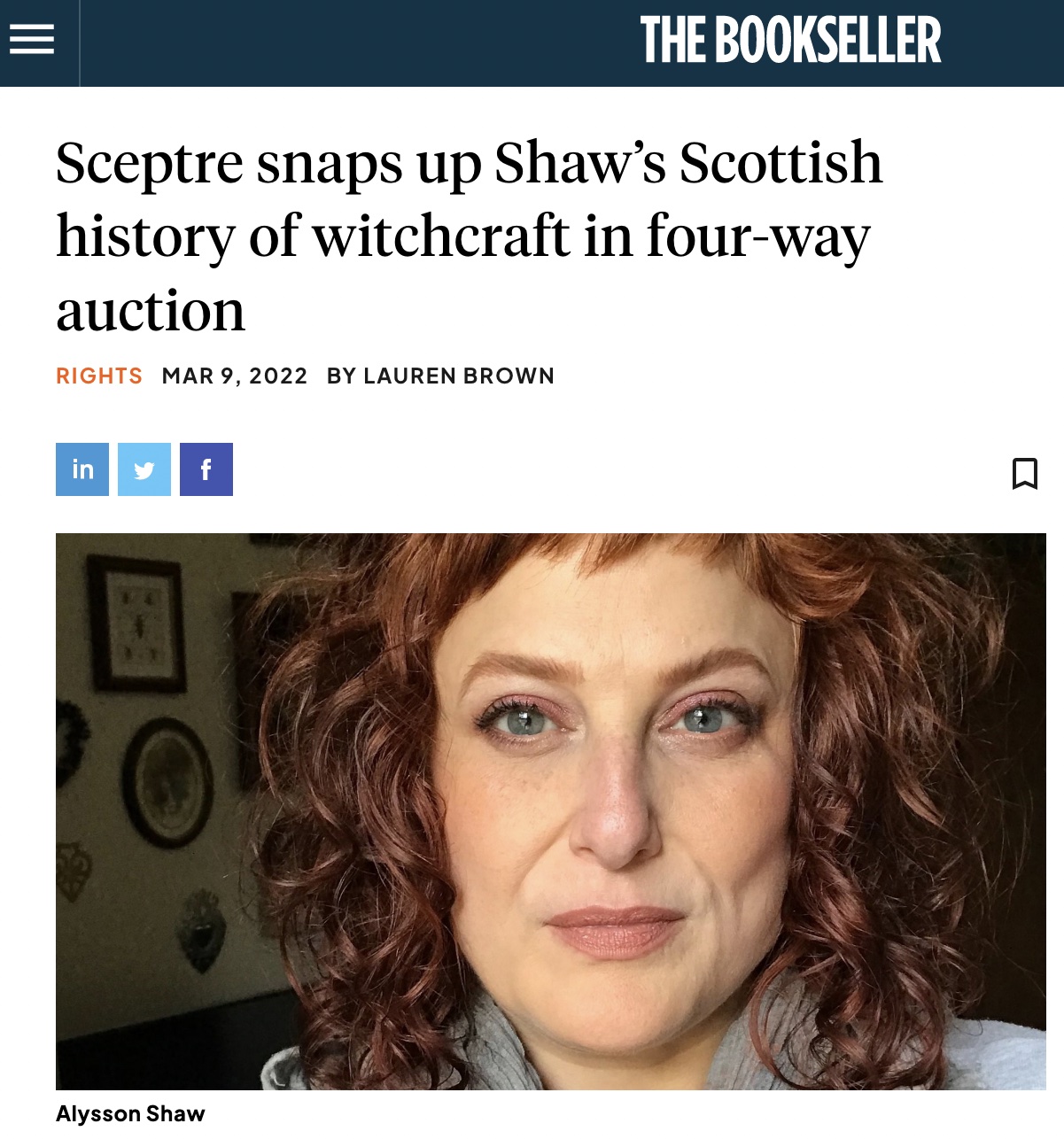
Headline from the Bookseller

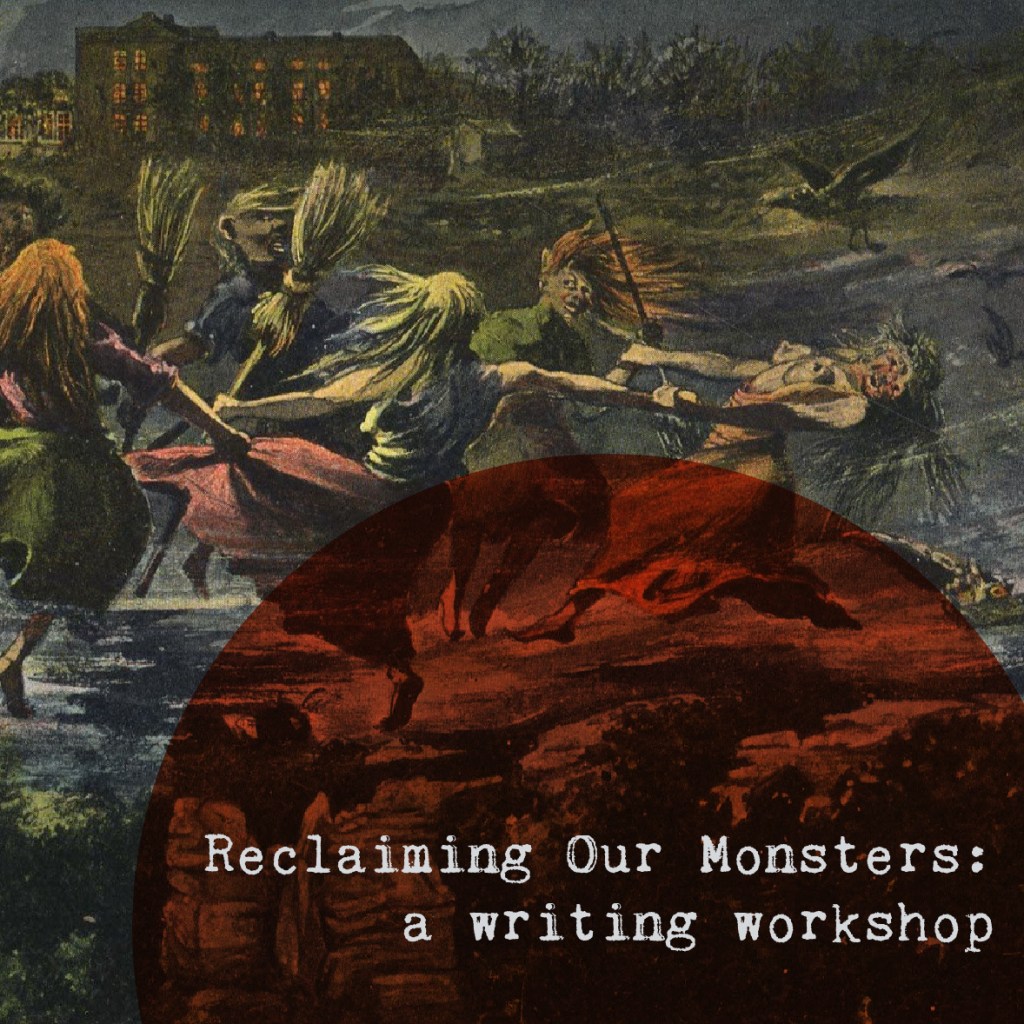
Reclaiming Our monsters: A writing workshop

Online via Zoom, April 30th, 7pm gmt Tickets are £25 available from Eventbrite

In this two hour workshop we’ll explore the monstrous through an intimate, personal perspective. We’ll embrace the persona of the outsider, the not-quite-human, using subversive world-building, and writing through the eyes of the cursed, the spellbound, the exiled. 

April 30th is the second Halloween of the witches’ calendar. The veil is thin, the dead walk among us, werewolves are born and all good witches fly to the Brocken. 

Let’s celebrate and write stories together. 

For this workshop you’ll need a pen, paper and a six sided die. 

 This workshop is driven by feminist ideas, reworking the monstrous into new empowering guises—but also a way to explore folk horror as a wider genre with space for women and non binary people. Every workshop I design is an offering of community, creative fuel and fire to the writers and makers around me. And this one is GONNA BE HELLA FUN. 

Enroll now.

Ghost Missives Online Writing Workshop

As part of the Winter’s Last program, I will presenting poetry as well as teaching an online writing workshop on January 29th. 

Ghost Missives: A Writing Workshop Exploring Ancestors and Place

The nights are long and the veil is thin. We tell tales of the dead in verse and song and they tell of us in the wind, rain, ice, and stone.  

In this collaborative workshop, I will facilitate the writing of letters in prose poetry to and from the ancestors.  The writing will be rooted the Scottish landscape. To set the tone, the session will begin with readings specific to the liminal landscape, and move on to collaborative work.  I will guide the group as they work with prompts or “Wilding Cards” I will have made up.  These will be exchanged by the group. After some dealing and discussion we will get down to write using the prompts we all have. Writers will be invited to play with voice, speaking from the point of view of our ancestors, ourselves or the land itself. In the final section of the workshop there will be opportunity for further collaboration between writers as well as time to read and share with the group.

For more information on tickets and other presenters and workshops, go to the Tiabhsear Collective website