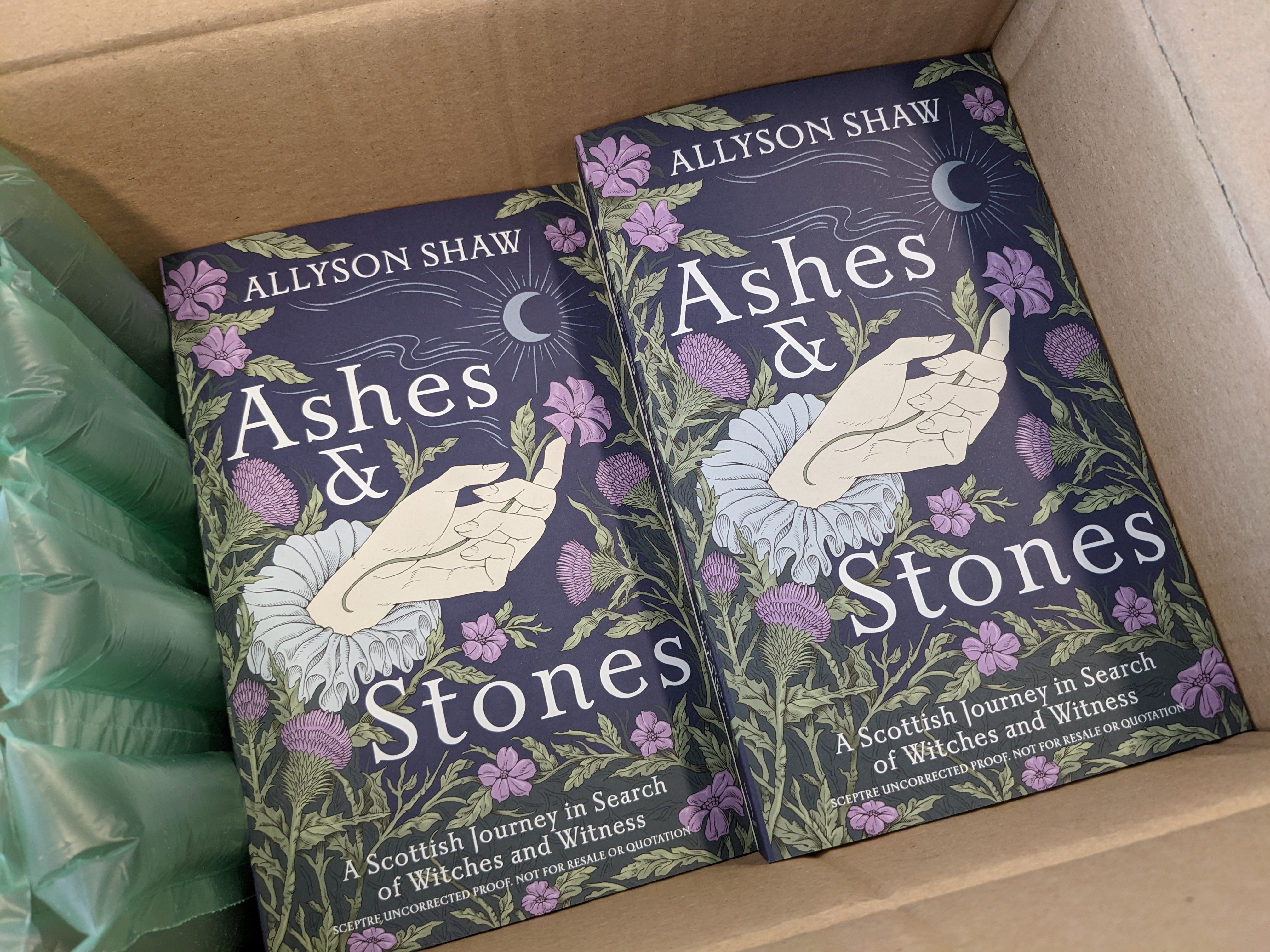
Tomorrow is my book birthday. Ashes & Stones, my creative nonfiction book about women persecuted as witches in Scotland, was published three years ago.
I began writing and researching the book over eight years ago. When I started the work, few people were talking about the history of witch hunts in Scotland, even though #witchythings were riding the capitalist zeitgeist. The witchwave was in full swing, with #instagramwitch influencer culture booming.
Trad publishing is always slow. It comes for trends after they have peaked and are near consumer exhaustion. My book was picked up during the feeding frenzy for witch books.
The sites I mapped and uncovered—sometimes literally—are now well known to Scottish tour guides. Stories uncovered during the countless hours combing through tedious old privy council records and emailing archeologists and other experts are now repeated as if they have always been common knowledge. Social media has made this possible, and we live in a time where citing your sources no longer matters.
I have never had a baby, but writing a book feels like having a baby—except this one gestated for over five years. And then I handed the baby over to strangers to do with it what they will. So maybe it’s not the best analogy.
But let’s go with it. A three year old might be able play with other children, take turns, and understand sharing, but my book came into a world where this isn’t encouraged. I set her on her way into a selfish, antisocial world, to be judged by the money she could make for others rather than for what she was.
Sometimes I still have pangs of grief about that rather than feelings of joyful achievement. BUT she is three! With thousands of readers (tens of thousands, perhaps). She can now also run and jump—into the hands of other readers who have been waiting to find her.
🧁 Celebrate with me. Here are some ideas:
If you are really feeling generous and have read the book, why not leave a review on one of the big sites that collect that kind of thing?
Why not check it out from your library or purchase it? Both of these matter—I get paid when these things happen.
If your library doesn’t have Ashes & Stones, why not request it?
If you know someone who would like my book, tell them about it!
If you are in Scotland, visit one of the sites I mention in the book. Leave a non-material offering. There are too many things littering our sacred sites. Instead, leave a song, words of remembrance or a prayer. If you light a candle, take it with you when you leave.
Also—as the ribbon on top—consider how we consume media. Things are getting tough out there for creatives. I know many of you reading this are in the same boat. Our work is being stolen. Business models that once supported us now turn to influencers to make culture. Our work is disseminated in ways that don’t benefit us, and there is nothing we can do about it. For instance, did you know that authors are not paid (at least not trad published authors) when you read the book on Kindle Unlimited or listen the audio book on Audible or Spotify? Even buying a used copy—great for the environment—means the author sees none of the money changing hands.
At the beginning of the month, the British newspaper The Observer ran a damning expose of author Raynor Winn. Her memoir The Salt Path is a ‘true story’ of a couple made homeless through property investments gone bad. The book recalls their survival walking hundreds of miles while her husband Timothy, or “Moth” in the books, struggles with corticobasal degeneration, a fatal chronic illness.
The publishing industry expects pathography as inspiration porn–juicy victimhood redeemed.
Since its publication in 2018, The Salt Path sold over two million copies and birthed a franchise of books where the couple go on long walks in different scenic places, hoping to ‘cure’ Moth. The publication of the fourth book in the series, due out in October, has been postponed.
The Observer article reveals that Winn’s actual name is Sally Ann Walker, and that she embezzled £64,000 from a former employer. At the time of their adventure in homelessness, the couple owned a property in France, still in their possession today. The article even calls into question Moth’s illness.
The Salt Path has always been a deeply ableist story. The redemptive narrative arc is especially toxic to those with chronic illness. ‘Walking off’ illness and the ‘sleeping rough’ cure–as The Salt Path proposes—is implausible and cruel. Yet, the success of this story is no surprise. The publishing industry expects pathography as inspiration porn–juicy victimhood redeemed.
Who doesn’t want a miracle, a triumph over the degeneration of the sick body and inevitable death? What if being cured is simply a question of attitude and right living? Cures involving positive thinking and mind-over-matter are the kind of poison Louise Hay, the author of Heal Your Body: The Mental Causes for Physical Illness and the Metaphysical Way to Overcome Them* and those like her, have disseminated. The Salt Path and the books that come after it propose that poverty and illness can be ameliorated by the right mindset and beautiful scenery—the will triumphs, love triumphs, and there is always a cure if you walk far enough.
At yet, there’s something fatalistic about Moth’s continued walking and sleeping rough, despite being in agony. While reading the books—and I have read them all—I often thought his unquestioning agreement to undertake these feats of endurance was not a plan for survival but a prolonged suicide attempt. The implication that he is healed by his ordeal is perhaps the most egregious lie of the books. It shouldn’t take an exposé to see this, but maybe it takes someone living with multiple, life long chronic illnesses to understand how absurd The Salt Path is.
The scandal of dishonest memoir is nothing new, but this particular ‘truth telling’ feeds the ableist notion that those of us living with chronic illness are fakers. As the British Labour government dismantles state support of disabled people, our survival becomes increasingly precarious. According to dominant ableist attitudes, ours is a culture of grifters. Lies at the heart of The Salt Path feed the myth that the homeless and chronically ill are scammers.
The Salt Path has haunted my own journey to publication, and the book made way for so many books like mine. In 2019, TheSalt Path won the Royal Society of Literature’s Christopher Bland Prize, an award given to authors with first books that are published after the age of 50. Ashes and Stones had the honour of being short listed for this same prize last year. My book has lived in The Salt Path’s shadow, even before publication. While the book proposal for Ashes & Stones was at auction, interested publishers compared it to The Salt Path. One editor asked me to elaborate on my ‘identity as a victim.’ I was told by another that my book could be marketed like Winn’s books. I watched Winn’s journey attentively—were there lessons to be learned?
I never considered myself a memoirist. Originally Ashes & Stones was poetic psychogeography, history and folklore. I was told by publishing professionals that in order to sell Ashes & Stones, I would have to put myself in it, so I chose to tell the truth, but tell it slant.** Any memoirist knows this compromise—success in circuit lies. All memoirists create a persona that tells their tale, just like a fiction writer would. Some readers who have contacted me feel that they know me—sometimes intimately. Who they think I am is a projection, a collaboration between the speaker in the book and their own reading of it. While writing the book, I left people and things out, respecting the wishes of some who did not want to be mentioned. I also deliberately slanted some details in order to be closer to the truth. In Ashes & Stones, I revealed things I’ve told very few people, believing it necessary for the integrity of the narrative. There’s something merciless about the exposure of memoir; I now live with that.
Sceptre, my UK publisher, edited Ashes & Stones brilliantly and for this I am deeply grateful. My book went through a legal read and thorough fact-checking during the editing process; I don’t know if this was the case with Winn’s books. Though Winn’s problematic obscuring of the truth now seems villainous, I also feel for her. There were millions who wanted her grotesque story to be true, and she gave it to them.
Like Winn, I was in my fifties when the publishing industry offered me a deal. I wanted, finally, after decades writing for small presses with little or no pay, to be published by one of the Big Five–global media giants capable of marketing a book and offering an advance. I agreed to add memoir if it meant the book would sell. In the end, I think my vulnerability adds to the immediacy of the women’s stories I tell In Ashes & Stones–I don’t regret including it. I wonder what Winn was asked to add to the book in order to sell it? I am not defending her—but I wonder how much she invented because she really wanted her book to be published. She or her publisher knew the truth wouldn’t sell, so she lied.
I am at heart a fiction writer. I came of age when tell-all memoirs of drug and sex addiction, incest and sexual violence were the rage. I was writing confessional poetry my twenties, but found myself in an unsafe MFA program. I could no longer expose myself in my work, so I began to write narratives about others whose lives resembled my own. I believed that pliant and nuanced fictions could tell truths no memoir ever could. I still believe this. Maybe this is the crux of it: readers are hungry for authenticity, yet truth is uncomfortable. The Industry–now run on a venture capitalist model–isn’t even looking in this direction.
These pedestals are high. When they turn to gibbets, they take others with them.
Part of the mythology of The Salt Path is that Winn wrote it down in a notebook called ‘Salted Blackberries’ and gave it to Timothy, or ‘Moth’ as a souvenir of their walk. The story goes, someone else insisted it should be a book—and the success just happened, with unassuming Winn thrust into meetings with bigwigs at publishing houses and the spotlight of awards and notoriety.
After four books, though, can we call bullsh*t? Anyone who survives the ordeal of publishing even one book has to really, really want be a published author. It is a Faustian bargain involving intense ambition and even greater luck. In my twenties I was close with a writer who went on to be a very famous memoirist indeed—also pursued by scandal. The cusp of her success came with a call from a Big Five publisher with a deal. She said—because it was spring—she would ‘fellate the Easter Bunny’ if it meant she would finally be published. I remember thinking at the time that I would never be like that, and I would look at success differently. If someone hadn’t made it, maybe it was just down to refusal: when the coney of opportunity presented themselves, they just said no.
Just like after the Neil Gaiman scandal broke, it is now easier to say I never liked the books. These pedestals are high. When they turn to gibbets, they take others with them. Readers highly invested in The Salt Path felt the characters were real because it was sold to them as a true story. The emotional pull of the book is Dickensian melodrama of the highest order: an innocent couple thrust into penury endures the callous disregard of an uncaring world even while love grows between them.
I’ve seen a lot of male pundits crowing about how they always thought the premise was iffy, but their wife/aunt/sister/mother loved it. Why is this gendered? Perhaps for some male readers, women nonfiction writers are questionable, anyway–whether we tell the truth or not. Melodrama has always been the secret language of women and marginalised genders. We have told stories full of magic and miracles, enduring love, from one to another, before anyone even thought to write them down. Beyond this philosophical notion, it’s also women who buy books—especially those written by women about women.
But why were so many taken in? The book sits in a collective blind spot that lies somewhere between sympathy, our love of fairy tale, and pity. The base sentimentality of books like The Salt Path allows us to indulge in the suffering of others while offering a palliative delusion on behalf of all those who are sick and poor. This fraudulent hope is meant for the misery of others—never our own.
*In the 1970s Louise Hay refused traditional medical treatment for her cervical cancer, attributing its onset to negative thoughts and unhealed trauma. She claims to have cured herself through forgiveness, reflexology and enemas. Her work expounded the idea that only those with a negative mindset are susceptible to disease.
Sally Ann Walker/Raynor Winn’s rebuttal to the charges, including clinic letters concerning her husband’s diagnosis: https://www.raynorwinn.co.uk/new-page
Before moving to Scotland, I was learning what I now call hedgewitchery, riding of metaphysical hedges using trance-work commonly referred to as shamanic journeying. In one journey I was given a piglet to hold and care for. That piglet changed my life. It was not long after this that I found the house in Banff in the Northeast of Scotland where I would write Ashes & Stones.
Piglet or Holy Woman?
The house in Banff was literally a leap of faith—into a new landscape with a history and different languages—Scots and Gaelic—with Doric dialect thrown in the mix. The etymology of the name Banff is contested. Is it derived from the Scottish Gaelic banbh meaning ‘piglet’ or is it a contraction of bean-naomh, Gaelic for ‘holy woman’?
Dolphins—those misunderstood, exploited people of the sea—are at the centre of this question. They are often spotted off the coastline at Banff, and all along the Northeast coast, dolphins are joyful part of the seascape. In 17th-18th century Scots, a mereswyne—sea pig—was a porpoise or dolphin.
Etymological name-puzzles carry over to Orkney, where I now live.
I am piglet, dragon, cetacean, and woman. What am I?
Orkney was known to Ptolemy and the Venerable Bede as Orcades, after the Latin orca meaning whale. (There are a lot of Orcas around Orkney.)
Before 16th century Scots mereswyne, Old English had mereswīn or porpoise. This linguistic link goes back farther still. Before early Modern Scots, before Old English and even before the Norse settlers, there were Iron Age Picts in Orkney called the Orcs. Little remains of their presence save a few expertly carved stones and their name. Orc is a Pictish tribal name meaning young pig. The 9th century Norse settlers met the Picts and either assimilated or destroyed them—no one knows. The settlers saw in the local tribal name Orc their word for seal—orkn. They reinterpreted the name and added eyjar, orislands, to make Orkneyjar—Seal Islands. (There are a lot of seals around Orkney, also.)
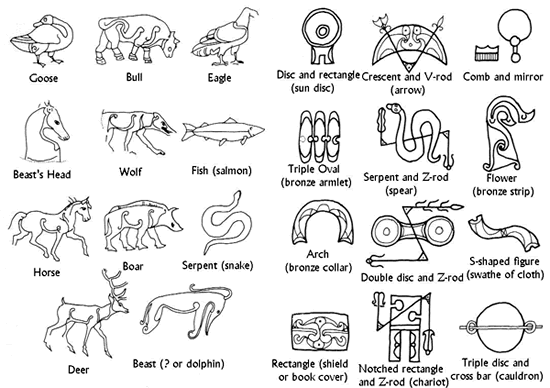
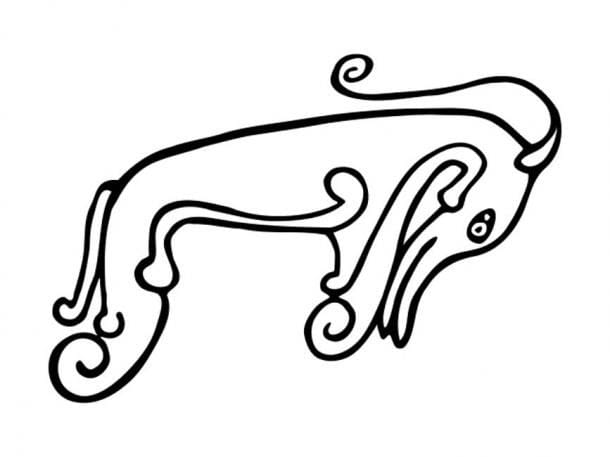
The Picts left elaborately carved stones all over Scotland, and some were re-carved with beautiful crosses as they converted to Christianity. The earlier symbols like the crescent and Z rod defy modern understanding, but the animal portraits on the stones show a keen intimacy with the being portrayed—an understanding of the anatomy and movement, of the animal’s presence. The beings on the stones are representations of animals we know today: eagles, boars, deer, bulls, salmon, serpents, bears and others. There’s one exception to this earthly menagerie—the mysterious Pictish ‘beast’. This dragon-like figure is most common on Pictish stones in Northeast Scotland.
Stylised Pictish Beast–Struthious Bandersnatch via wikimedia commons
These stones are rare in Orkney and the Pictish beast is rarer still. In 2016 a violent storm revealed an 8th century Pictish stone wedged in a cliff face in Deerness on the east Mainland. On one side is an elaborately carved Celtic cross, with a Pictish beast on the other.
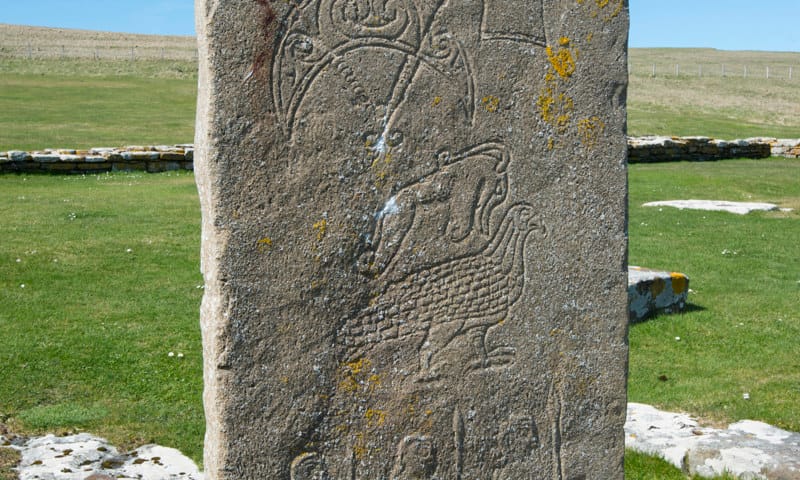
Reproduction of the Pictish Stone on Birsay via the Visit Orkney Website
A second Pictish beast was found on a stone on the tidal island of Birsay, carved above another totemic Orkney animal—the sea eagle. Some have argued that the beast is a dragon or kelpie (a water-horse in Scottish folklore), but others see the beast as a dolphin—and I’m inclined to agree.
Marioun
Marioun Pardoun (also named Peblis and Peebles in the record) was executed for the crime of witchcraft in Scalloway in Shetland on the 22nd of March, 1644. She was accused of magically overturning a boat, causing four men to drown. When the bodies were found, Marioun and her husband were required to put their hands on the corpses to determine their innocence. The bodies bled and, in the logic of the time, this proved her guilt. (There is no mention of the husband in the trial record except in Marioun’s tortured reverie.) Details of her ‘waking’ or sleep deprivation were recorded, and her torturers are named—Mans Finlaysone and Jon Erasmussone. The greater the pressure they put on her, the more incoherent her confession became.
(I translate these words from Helene Willumsen’s transcription of the trial record into contemporary diction.) ‘…when they were waking her she asked where was the husband who was answering her? Speaking concerning her husband, she answered [that] he lay under her head and would not suffer her to confess.’ An accusation is noted in the margin of the trial record: Clothing your spirit with said pellock quaill. A pellock quaill is a dolphin.
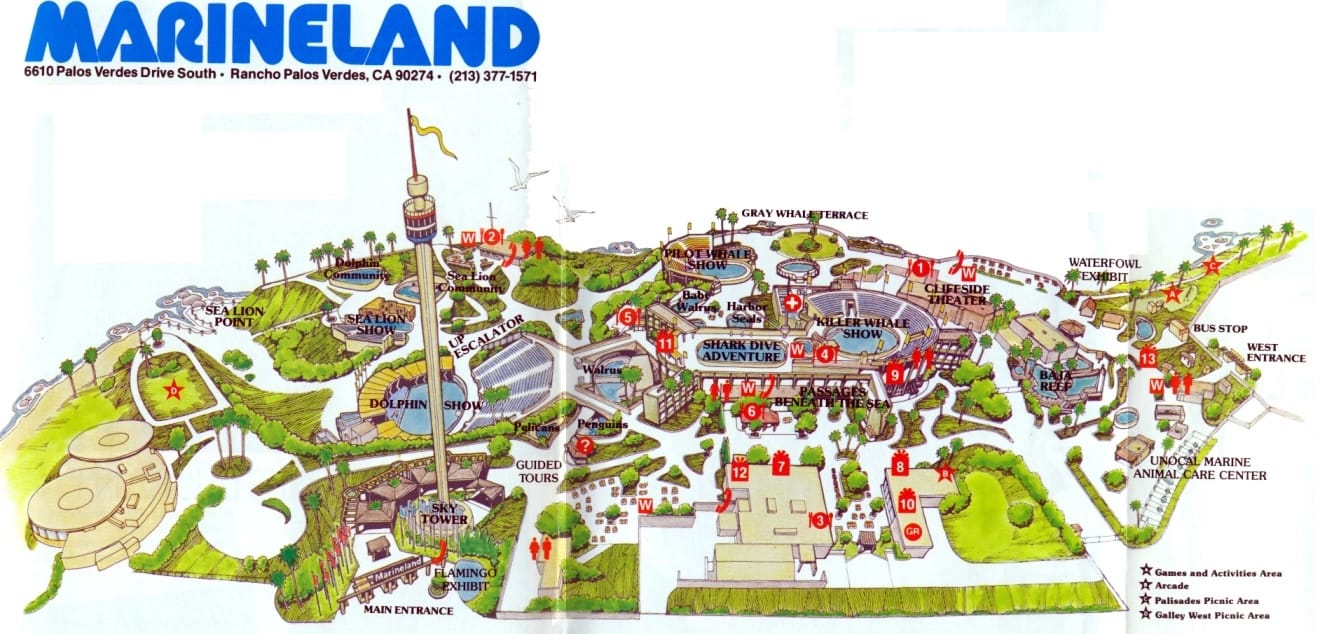
A map of the water circus Marineland in the 1980s
Captive
When I was a child I liked to listen to whale and dolphin sounds. I loved their throat songs—the clicking giggles, whistles of joy and foreboding above bass drop of deep water. I had a flexidisc from an issue of National Geographic that I played over and over on my portable turntable. When we moved from the midwest to Southern California, my father took me to Marineland to see some dolphins. It was 1986, a year before the grim place would close for good. Years after my visit, it remained a ruined, graffittied site used by locals as a makeshift skate park until it was developed into a resort. All of this is now sinking into the sea, including the 18th hole at the adjacent Trump golf course. Nostalgic, surreal reveries on Reddit are my only corroborators, with one poster using the phrase ‘fever dream’ to describe their memories of late 80s Marineland. It was once the world’s largest water circus, housing captive dolphins, orcas and seals. Orcas and pilot whales were forced to perform in tiny tanks—their lives often short and tortured. Dolphins leapt through hoops of fire and sea lions were forced to ‘sing’.
In my recollection, only my father and I are there, standing in wonder before the green murk of the empty ‘shark experience’ tank. We meander through the sun bleached park, around show tanks, their artificial blue depths mirror-still, as if before a storm. I stand alone beside the ‘Dolphin Community Tank’ and a being surfaces. She breathes. I put my hand out and touch the pale grey slip of her forehead. She looks at me and I am in the presence of a spirit clothed with pellock quaill. Her black eye takes me in–looks past to all beyond—over the walls of the park to the wide, bright sea.
Further explorations
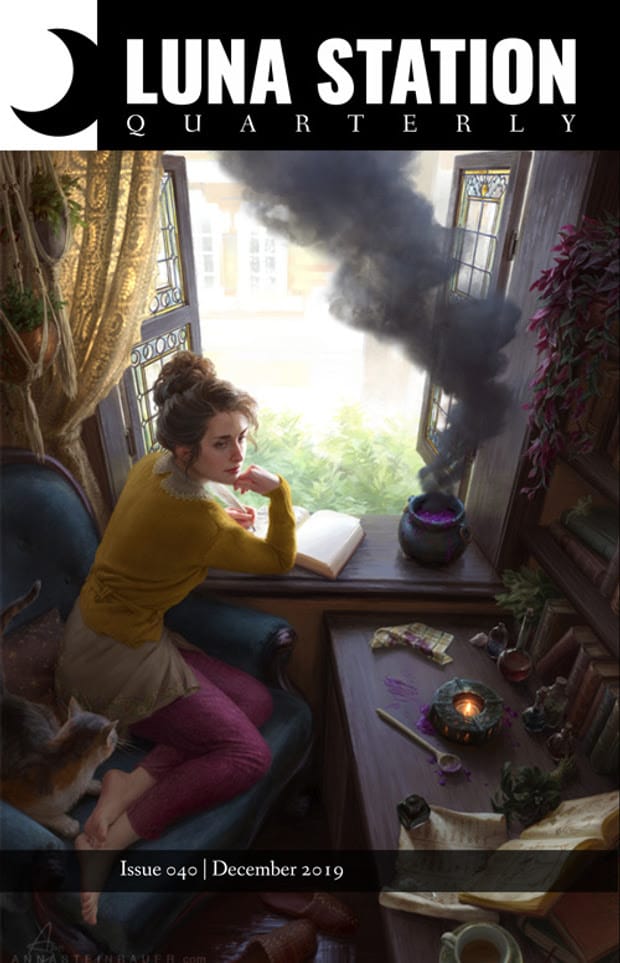
—Tales of Pictish beasts and dolphin transformations inspired my short story, ‘Gald.’ A chance meeting in a post apocalyptic Aberdeenshire changes two young women’s lives forever. You can read it in Luna Station Quarterly, issue 40—available as a paperback and ebook: https://www.lunastationquarterly.com/issues/040/
—Take a stand against the horrific slaughter of whole pods of pilot whales and dolphins in the annual Grindadráp hunt in the Faroe Islands. Just this month, 291 pilot whales were slaughteredin the village of Leynar, including pregnant females and juveniles.Boycott tourism to the Faroe Islands and encourage others to do so. Put pressure on the Faroe Islands government to put an end to this cruel ‘tradition’ that threatens the future of the pilot whale. Find out more here (warning–this link shows footage of the hunt and contains the graphic and violent animal cruelty of the hunt.) https://seashepherd.org/faroeislands/. If you would like to take action without seeing these images, go to this page to write to officials directly.
—Dolphin photographer with the Whale and Dolphin conservation society Charlie Philips regularly records and posts beautiful images of Dolphins from the Moray Firth on Mastodon
—Laline Paul’s brilliant Pod will haunt you eternally.
This is a remarkable book alive with the beauty and terror of Scotland centuries earlier – as if the author reached out a hand and took the reader with her on that journey…The delicate balance between Allyson Shaw’s inner life and personal reasons for making the journey set against the stories of those whose lives were lost is beautifully rendered, while the writing throughout is sublime.
Excerpt from Nicola Sturgeon’s speech on International Women’s Day
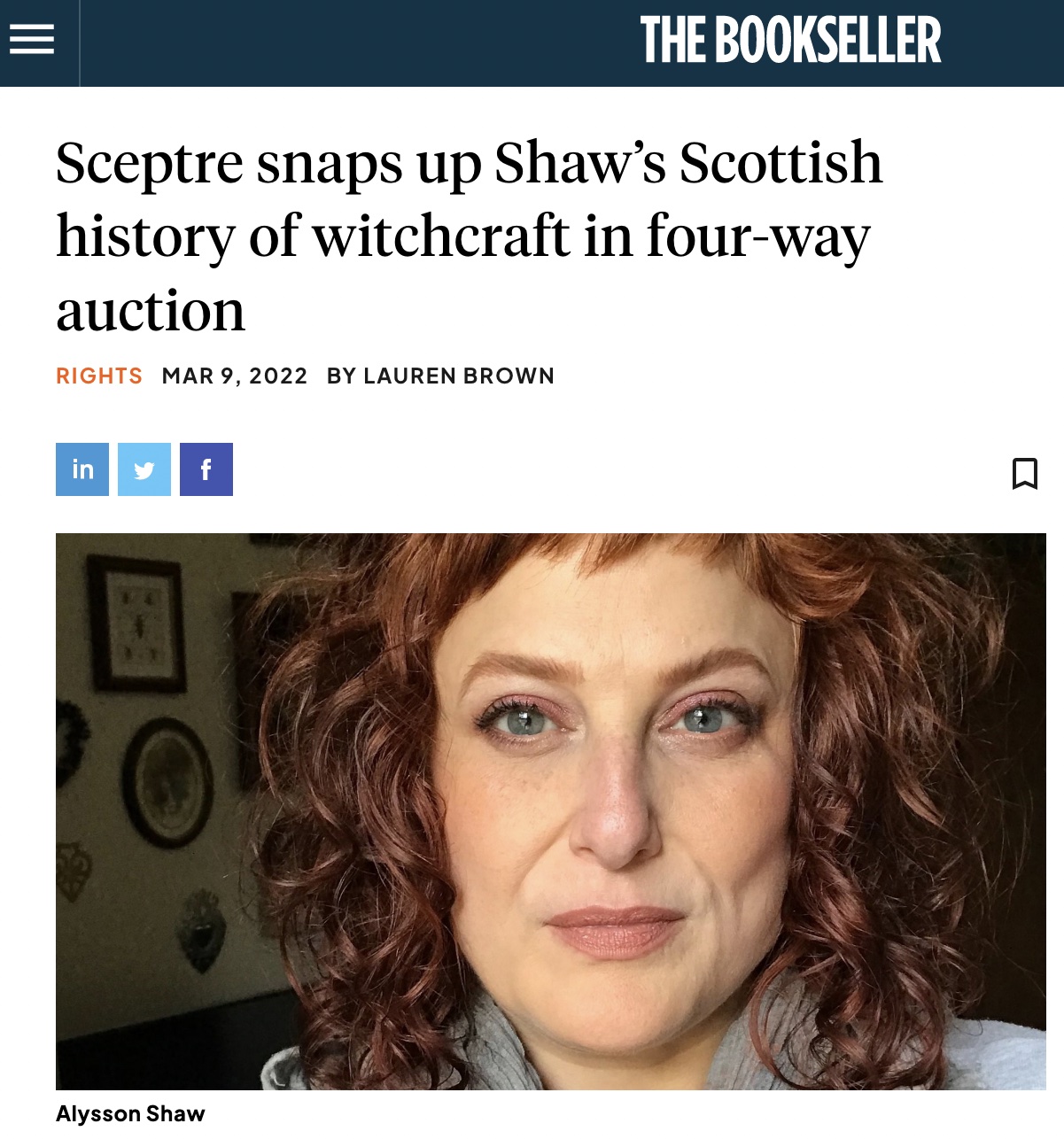
I longed for an authentic glimpse of the women executed for witchcraft hundreds of years ago, and I went out into the landscape to meet them. Their voices and lives became braided with my own in moving and unexpected ways. I’m excited that Sceptre will bring this humanising perspective on the accused to a wider audience.’
–Allyson Shaw
The day after Nicola Sturgeon issued a formal apology for those accused of witchcraft in Scotland, Sceptre has publicised the press release for my book on the same topic. It is wonderful timing. Sturgeon’s apology is healing not only the past but present and future misogyny. I am moved to tears and so proud to be Scottish right now.
From the Ashes and Stones trade announcement:
Ashes and Stones is a moving and personal journey, along rugged coasts and through remote villages and modern cities, in search of the traces of those accused of witchcraft in seventeenth-century Scotland. We visit modern memorials, roadside shrines and standing stones and roam among forests and hedge mazes, folk lore and political fantasies. From fairy hills to forgotten caves, we explore a spellbound landscape.
Allyson Shaw untangles the myth of witchcraft and gives voice to those erased by it. Her elegant and lucid prose weaves threads of history and feminist reclamation, alongside beautiful travel, nature and memoir writing, to create a vibrant memorial. This is the untold story of the witches’ monuments of Scotland and the women’s lives they mark. Ashes and Stones is a trove of folklore linking the lives of modern women to the horrors of the past, and it is record of resilience and a call to choose and remember our ancestors.
Charlotte Humphery, Senior Commissioning Editor at Sceptre, who is working with Francine Toon’s authors while Toon is on parental leave, says: ‘Ashes and Stones is a beautiful exploration of a dark history that is often forgotten or trivialised. Thousands of women were murdered by state forces during the witch hunts and Allyson Shaw revives some of these women – through historical records, physical presence and informed imagination – with tenderness and compassion. In this book, she has created her own memorial that is rich with magic of folk lore and the power of the Scottish landscape and resonant with the politics of today. We are delighted to be publishing this brilliant and important book.’
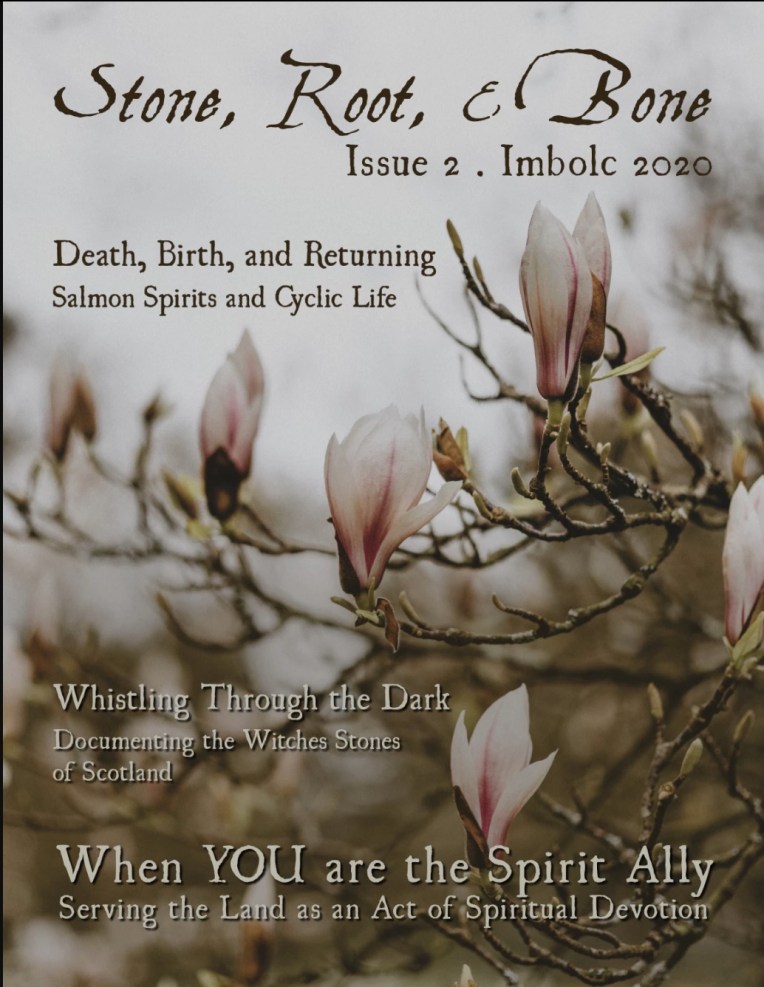
My short piece on the witches stone of Forres has been published in the Imbolc issue of Stone Root and Bone, available from Hagstone Press here.
This wonderful publisher might be of interest to the knitters reading my blog– they not only publish this quarterly journal but also lovely knitting patterns with pagan themes.




 Allyson Shaw, Author of Ashes and Stones