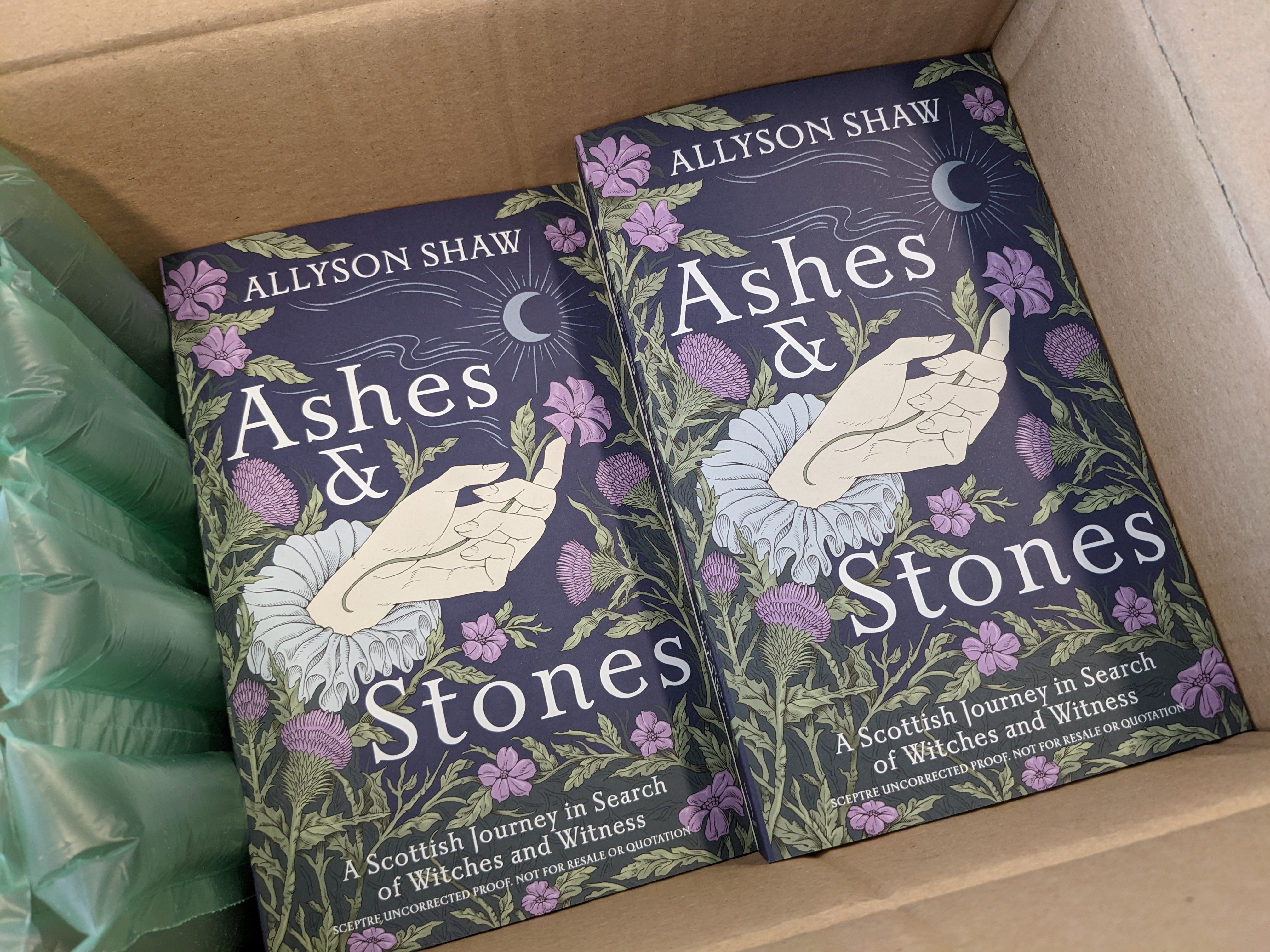
Tomorrow is my book birthday. Ashes & Stones, my creative nonfiction book about women persecuted as witches in Scotland, was published three years ago.
I began writing and researching the book over eight years ago. When I started the work, few people were talking about the history of witch hunts in Scotland, even though #witchythings were riding the capitalist zeitgeist. The witchwave was in full swing, with #instagramwitch influencer culture booming.
Trad publishing is always slow. It comes for trends after they have peaked and are near consumer exhaustion. My book was picked up during the feeding frenzy for witch books.
The sites I mapped and uncovered—sometimes literally—are now well known to Scottish tour guides. Stories uncovered during the countless hours combing through tedious old privy council records and emailing archeologists and other experts are now repeated as if they have always been common knowledge. Social media has made this possible, and we live in a time where citing your sources no longer matters.
I have never had a baby, but writing a book feels like having a baby—except this one gestated for over five years. And then I handed the baby over to strangers to do with it what they will. So maybe it’s not the best analogy.
But let’s go with it. A three year old might be able play with other children, take turns, and understand sharing, but my book came into a world where this isn’t encouraged. I set her on her way into a selfish, antisocial world, to be judged by the money she could make for others rather than for what she was.
Sometimes I still have pangs of grief about that rather than feelings of joyful achievement. BUT she is three! With thousands of readers (tens of thousands, perhaps). She can now also run and jump—into the hands of other readers who have been waiting to find her.
🧁 Celebrate with me. Here are some ideas:
If you are really feeling generous and have read the book, why not leave a review on one of the big sites that collect that kind of thing?
Why not check it out from your library or purchase it? Both of these matter—I get paid when these things happen.
If your library doesn’t have Ashes & Stones, why not request it?
If you know someone who would like my book, tell them about it!
If you are in Scotland, visit one of the sites I mention in the book. Leave a non-material offering. There are too many things littering our sacred sites. Instead, leave a song, words of remembrance or a prayer. If you light a candle, take it with you when you leave.
Also—as the ribbon on top—consider how we consume media. Things are getting tough out there for creatives. I know many of you reading this are in the same boat. Our work is being stolen. Business models that once supported us now turn to influencers to make culture. Our work is disseminated in ways that don’t benefit us, and there is nothing we can do about it. For instance, did you know that authors are not paid (at least not trad published authors) when you read the book on Kindle Unlimited or listen the audio book on Audible or Spotify? Even buying a used copy—great for the environment—means the author sees none of the money changing hands.
At the beginning of the month, the British newspaper The Observer ran a damning expose of author Raynor Winn. Her memoir The Salt Path is a ‘true story’ of a couple made homeless through property investments gone bad. The book recalls their survival walking hundreds of miles while her husband Timothy, or “Moth” in the books, struggles with corticobasal degeneration, a fatal chronic illness.
The publishing industry expects pathography as inspiration porn–juicy victimhood redeemed.
Since its publication in 2018, The Salt Path sold over two million copies and birthed a franchise of books where the couple go on long walks in different scenic places, hoping to ‘cure’ Moth. The publication of the fourth book in the series, due out in October, has been postponed.
The Observer article reveals that Winn’s actual name is Sally Ann Walker, and that she embezzled £64,000 from a former employer. At the time of their adventure in homelessness, the couple owned a property in France, still in their possession today. The article even calls into question Moth’s illness.
The Salt Path has always been a deeply ableist story. The redemptive narrative arc is especially toxic to those with chronic illness. ‘Walking off’ illness and the ‘sleeping rough’ cure–as The Salt Path proposes—is implausible and cruel. Yet, the success of this story is no surprise. The publishing industry expects pathography as inspiration porn–juicy victimhood redeemed.
Who doesn’t want a miracle, a triumph over the degeneration of the sick body and inevitable death? What if being cured is simply a question of attitude and right living? Cures involving positive thinking and mind-over-matter are the kind of poison Louise Hay, the author of Heal Your Body: The Mental Causes for Physical Illness and the Metaphysical Way to Overcome Them* and those like her, have disseminated. The Salt Path and the books that come after it propose that poverty and illness can be ameliorated by the right mindset and beautiful scenery—the will triumphs, love triumphs, and there is always a cure if you walk far enough.
At yet, there’s something fatalistic about Moth’s continued walking and sleeping rough, despite being in agony. While reading the books—and I have read them all—I often thought his unquestioning agreement to undertake these feats of endurance was not a plan for survival but a prolonged suicide attempt. The implication that he is healed by his ordeal is perhaps the most egregious lie of the books. It shouldn’t take an exposé to see this, but maybe it takes someone living with multiple, life long chronic illnesses to understand how absurd The Salt Path is.
The scandal of dishonest memoir is nothing new, but this particular ‘truth telling’ feeds the ableist notion that those of us living with chronic illness are fakers. As the British Labour government dismantles state support of disabled people, our survival becomes increasingly precarious. According to dominant ableist attitudes, ours is a culture of grifters. Lies at the heart of The Salt Path feed the myth that the homeless and chronically ill are scammers.
The Salt Path has haunted my own journey to publication, and the book made way for so many books like mine. In 2019, TheSalt Path won the Royal Society of Literature’s Christopher Bland Prize, an award given to authors with first books that are published after the age of 50. Ashes and Stones had the honour of being short listed for this same prize last year. My book has lived in The Salt Path’s shadow, even before publication. While the book proposal for Ashes & Stones was at auction, interested publishers compared it to The Salt Path. One editor asked me to elaborate on my ‘identity as a victim.’ I was told by another that my book could be marketed like Winn’s books. I watched Winn’s journey attentively—were there lessons to be learned?
I never considered myself a memoirist. Originally Ashes & Stones was poetic psychogeography, history and folklore. I was told by publishing professionals that in order to sell Ashes & Stones, I would have to put myself in it, so I chose to tell the truth, but tell it slant.** Any memoirist knows this compromise—success in circuit lies. All memoirists create a persona that tells their tale, just like a fiction writer would. Some readers who have contacted me feel that they know me—sometimes intimately. Who they think I am is a projection, a collaboration between the speaker in the book and their own reading of it. While writing the book, I left people and things out, respecting the wishes of some who did not want to be mentioned. I also deliberately slanted some details in order to be closer to the truth. In Ashes & Stones, I revealed things I’ve told very few people, believing it necessary for the integrity of the narrative. There’s something merciless about the exposure of memoir; I now live with that.
Sceptre, my UK publisher, edited Ashes & Stones brilliantly and for this I am deeply grateful. My book went through a legal read and thorough fact-checking during the editing process; I don’t know if this was the case with Winn’s books. Though Winn’s problematic obscuring of the truth now seems villainous, I also feel for her. There were millions who wanted her grotesque story to be true, and she gave it to them.
Like Winn, I was in my fifties when the publishing industry offered me a deal. I wanted, finally, after decades writing for small presses with little or no pay, to be published by one of the Big Five–global media giants capable of marketing a book and offering an advance. I agreed to add memoir if it meant the book would sell. In the end, I think my vulnerability adds to the immediacy of the women’s stories I tell In Ashes & Stones–I don’t regret including it. I wonder what Winn was asked to add to the book in order to sell it? I am not defending her—but I wonder how much she invented because she really wanted her book to be published. She or her publisher knew the truth wouldn’t sell, so she lied.
I am at heart a fiction writer. I came of age when tell-all memoirs of drug and sex addiction, incest and sexual violence were the rage. I was writing confessional poetry my twenties, but found myself in an unsafe MFA program. I could no longer expose myself in my work, so I began to write narratives about others whose lives resembled my own. I believed that pliant and nuanced fictions could tell truths no memoir ever could. I still believe this. Maybe this is the crux of it: readers are hungry for authenticity, yet truth is uncomfortable. The Industry–now run on a venture capitalist model–isn’t even looking in this direction.
These pedestals are high. When they turn to gibbets, they take others with them.
Part of the mythology of The Salt Path is that Winn wrote it down in a notebook called ‘Salted Blackberries’ and gave it to Timothy, or ‘Moth’ as a souvenir of their walk. The story goes, someone else insisted it should be a book—and the success just happened, with unassuming Winn thrust into meetings with bigwigs at publishing houses and the spotlight of awards and notoriety.
After four books, though, can we call bullsh*t? Anyone who survives the ordeal of publishing even one book has to really, really want be a published author. It is a Faustian bargain involving intense ambition and even greater luck. In my twenties I was close with a writer who went on to be a very famous memoirist indeed—also pursued by scandal. The cusp of her success came with a call from a Big Five publisher with a deal. She said—because it was spring—she would ‘fellate the Easter Bunny’ if it meant she would finally be published. I remember thinking at the time that I would never be like that, and I would look at success differently. If someone hadn’t made it, maybe it was just down to refusal: when the coney of opportunity presented themselves, they just said no.
Just like after the Neil Gaiman scandal broke, it is now easier to say I never liked the books. These pedestals are high. When they turn to gibbets, they take others with them. Readers highly invested in The Salt Path felt the characters were real because it was sold to them as a true story. The emotional pull of the book is Dickensian melodrama of the highest order: an innocent couple thrust into penury endures the callous disregard of an uncaring world even while love grows between them.
I’ve seen a lot of male pundits crowing about how they always thought the premise was iffy, but their wife/aunt/sister/mother loved it. Why is this gendered? Perhaps for some male readers, women nonfiction writers are questionable, anyway–whether we tell the truth or not. Melodrama has always been the secret language of women and marginalised genders. We have told stories full of magic and miracles, enduring love, from one to another, before anyone even thought to write them down. Beyond this philosophical notion, it’s also women who buy books—especially those written by women about women.
But why were so many taken in? The book sits in a collective blind spot that lies somewhere between sympathy, our love of fairy tale, and pity. The base sentimentality of books like The Salt Path allows us to indulge in the suffering of others while offering a palliative delusion on behalf of all those who are sick and poor. This fraudulent hope is meant for the misery of others—never our own.
*In the 1970s Louise Hay refused traditional medical treatment for her cervical cancer, attributing its onset to negative thoughts and unhealed trauma. She claims to have cured herself through forgiveness, reflexology and enemas. Her work expounded the idea that only those with a negative mindset are susceptible to disease.
Sally Ann Walker/Raynor Winn’s rebuttal to the charges, including clinic letters concerning her husband’s diagnosis: https://www.raynorwinn.co.uk/new-page
This is a remarkable book alive with the beauty and terror of Scotland centuries earlier – as if the author reached out a hand and took the reader with her on that journey…The delicate balance between Allyson Shaw’s inner life and personal reasons for making the journey set against the stories of those whose lives were lost is beautifully rendered, while the writing throughout is sublime.
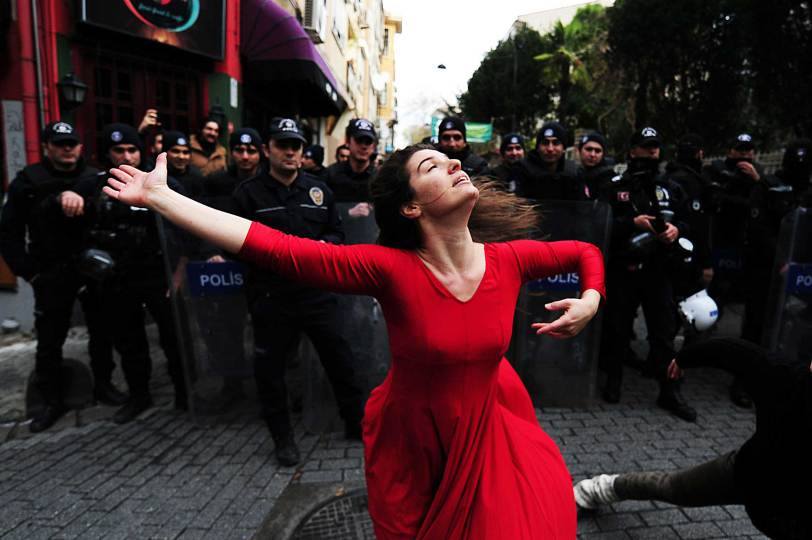
A woman dances in front of riot police during a demonstration in the Kadikoy neighborhood of Istanbul against the eviction of a squatted building. 2014 (Photograph by Ozan Kose—AFP/Getty Images) From Time’s FB page
Twenty years ago I wrote a novel about rebellion in a world dominated by AI. Much of the subversion took place in the character’s bodies, in their resistance to invasive tech. In the opening scene, a cadre of dancing women confront riot police. This novel wasn’t published, but it’s message seems almost prophetic now.
Climate change, dystopias and looming apocalypse are our shared reality. If we are to write anything hopeful or subversive, we must start where we are—without denying the darkness—and see beyond it. This way of seeing is felt, danced and wept into being. It is somatic. To know it, we must return to the body as a teacher. In Silvia Federici’s essay, In Praise of the Dancing Body, she sets out her argument that the body is a site of resistance:
,,,the body as a ground of resistance, that is the body and its powers – the power to act, to transform itself and the world and the body as a natural limit to exploitation.
Federici’s Caliban and the Witch had a deep influence on my historical analysis in my book about the Scottish witch hunts, Ashes & Stones. The 16th-17th century saw vast privatisation of public land, and this coincided with the witch hunts in Europe.
Capitalism was born from the separation of people from the land and its first task was to make work independent of the seasons and to lengthen the workday beyond the limits of our endurance. —Silvia Federici
We now see another vast privatisation of public and personal space—our shared online lives. Friendships and communities are now manipulated and distorted by insatiable capitalists. Creative work of artists and writers is fed to generative plagiarism machines, regurgitated in endless permutations of soulless productivity.
Some of us remember the early days of the internets; INFORMATION WANTS TO BE FREE was the rallying cry of DIY coders and archivists.
That is still true, but we are up against mighty foes.
What does the body have to do with this? I have often turned to my own body for its wealth of somatic knowledge—as a dancer, spirit worker, and someone who must harness chronic pain as a teacher.
In pre-capitalist societies people thought they had the power to fly, to have out-of body experiences, to communicate, to speak with animals and take on their powers and even shape-shift. —Silvia Federici
A sense of loss persisted as I wrote Ashes & Stones, not only of individual lives but shared folklore and even body-experiences that linked our ancestors to other worlds, other beings and ways of knowing. This somatic birthright, now lost—can only be rebuilt from dream, sensation and muscle memory. Perhaps shared folklore once contained some of this knowledge demonised during the witch hunts. Whatever was written down or remembered comes to us through that distorted, Christianised lens. We must remake it.
(My only beef with Federici’s brilliant essay is the suggestion that all Western medicine undermines the body’s integrity. My life has been saved over and over by Western medicine as have the lives of my friends. There must be a middle road when thinking of wellness.)
Reading : The Memory Police, Yoko Ogawa
The Memory Police. Yoko Ogawa. This sparse and elegant novel is about communal forgetting in the face of fascist takeover. Set on an invented island in Japan, it is a Kafkaesque fable that is delicately told. Though it was written in 1994, it is heartbreaking relevant right now.
Listening to: Fiona Soe Paing
Fiona Soe Paing with Bennachie in the distance. Found on the Bella Calledonia webstie.
I’ve had Sand, Silt and Flint by Fiona Soe Paing on repeat since my pal, photographer Jannica Honey told me about it. Traditional ballads and original compositions from the North East of Scotland are rendered anew. Listen and you will hear the sound of this landscape . Even after I’ve left, I feel this Doric place and these songs echoing in me like peals in bells.
Watching: Smoke Sauna Sisterhood
Promotional image for Smoke, Sauna, Sisterhood
This documentary is really intense and visually lush. It is about women talking to each other in a sauna, but it is also about the shape and texture of not only the women’s bodies, their voices and minds but also the spirit of the sauna itself. The sauna tradition in Estonia is recognised as a UNESCO intangible heritage, and the film is a personal exploration of this traditon. (I can’t unpack here the politics of women-only spaces in our current political moment. Humanity is evolving and ideas of gender as a spectrum are liberatory. Binary traditions need to be examined, dismantled- yet, many, like the smoke sauna depicted in the film, should to be honoured in living memory, especially in the face of patriarchal backlash, even as they are re-invented.
The documentary reminded me of sacred spaces that facilitate healing of both body and soul. This must happen outside of ‘new age’ commodification of this concept, beyond ‘toxic positivity.’
Once upon a time in San Francisco, there was a place called Osento, a woman’s bath house at 955 Valencia. Taking the waters there among others was transformational for me, an integral part of healing from sexual trauma. It is no more, Like so much of San Francisco that was vibrant and exciting while I lived there in the late 80s-early 90s. It’s vanished like something from Ogawa’s novel.
revisiting the Janet Horne Memorial Stone on the full moon 🌝
Last month I watched She Will, an impressionistic, feminist horror film about Scottish witches set in the Highlands. Aging film star Veronica Ghent travels to a remote location to convalesce and instead finds herself transformed by the darkness she encounters there.
I missed this film when it came out in 2021, but it’s a cinematic companion to my book about how Scotland remembers the witch hunts. The book is calledAshes & Stones. She Will is a film about memory, femicide and the ‘uses’ of the dead. It is also about confronting past trauma—both personal and historical— while dismantling toxic, predatory masculinity. In the film, as in life, these things happen simultaneously. Yet their relationship remains mysterious in the film: ashes billowing through the air are called ‘witch feathers’ by the locals, and the lore surrounding the land claims the death of women hundreds of years ago gives the earth curative properties.
1940s postcard of the Lairig Ghru Pass in the forest where the film takes place. Printed in Dundee—found on @cornovia_postcards@mstdn.business on Mastodon.
I am intimately familiar with the filming locations of She Will. In the ‘art class scene’ Veronica sits with her easel beside Loch an Eilein in the forest of Rothiemurchus. A boulder inscribed with witch marks lies behind her, off camera. Did the film makers know this? There are legends surrounding the atmospheric, 14th century castle on the island. There was once an underwater, zig-zag causeway linking the island to the shore, though this has never been found. Legend also claims it is the ancestral seat of the Shaw clan in the 14th century—if one believes these things.*
The castle on the island in Loch An Eilein. You could say I was visiting relatives—taken on Christmas Day, 2019
I loved the film’s powerful vision of bonds women share with both the living and dead. It’s also a delicious tale of revenge. I only wished it were longer, and that the character of Desi Hatoum, in a show-stopping performance by Kota Eberhardt, had been given more of a story.
The Janet Horne Memorial Stone in Dornoch is part of the film, transported to a woodland setting. I wrote a piece about the Janet Horne Memorial stone for the Association for Scottish Literature’s online journal, The Bottle Imp in 2019. Did the film makers read it? There is probably no way to know, but I like to think they did.
As part of my research for Ashes & Stones, I repeatedly visited the Janet Horne Memorial Stone. Each time I visited, it was different, surrounded by different tributes that have increased since the book was published. Janet Horne is not the name of the woman who supposedly died near the stone’s present location. Everything we know of her vague story was written down one hundred years after her death, in the notes of English occupiers who wanted to portray Highland Scots as superstitious, backward and unable to rule themselves. She is supposedly the ‘last witch’ executed in Scotland but there is no ‘true story’ of Janet Horne’s life or death, only invention.
In my research I found many photos of the stone through the ages, some from the Dornoch Historical Society and others on the internet without attribution. Here is a gallery.
*This notion is put forth in LOCH AN EILEIN AND ITS CASTLE by Alex Inkson M’Connochie. in The Cairngorm Club Journal 014, 1900.
Have you enjoyed this post? Make a one-time donation!
Choose an amount
£5.00
£10.00
£15.00
Or enter a custom amount
£
Your contribution helps me to keep researching, writing and making work.
Ashes & Stones: a Scottish Journey In Search of Women Hunted as Witches is an US Amazon Daily Deal this Monday, October 28th. Kindle edition is only $1.99 for one day only!





 Allyson Shaw, Author of Ashes and Stones